


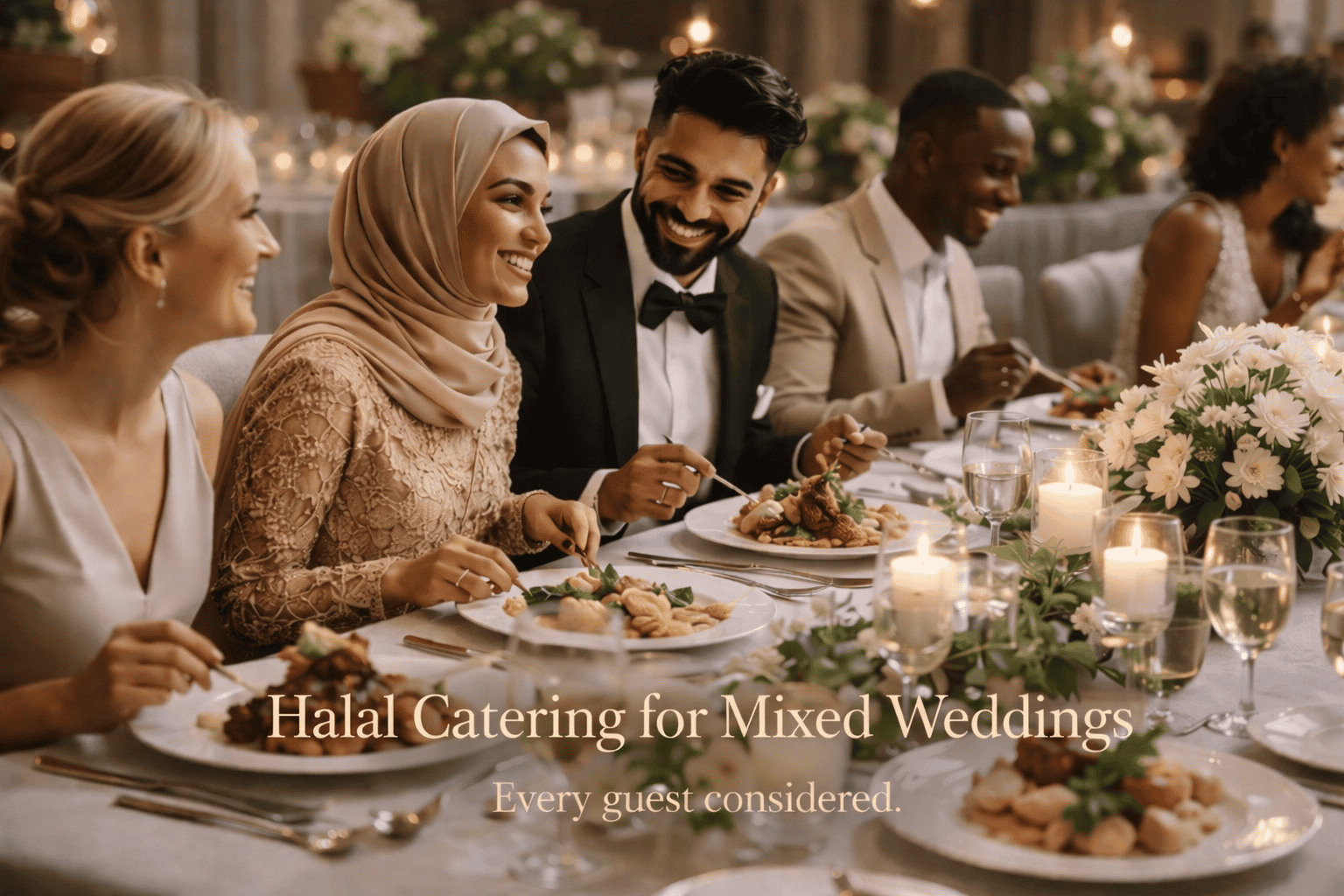
Halal Catering for Mixed Weddings: How to Keep Every Guest Happy Without Compromising on Faith
There’s a particular kind of joy that comes with an intercultural wedding. Two families, sometimes from very different backgrounds, coming together over shared food, shared laughter, and a shared wish for the couple at the centre of it all. But alongside that joy, there’s often a quiet anxiety in the planning — especially around the table.
How do you serve food that genuinely respects Islamic dietary law, whilst making sure your non-Muslim guests feel equally considered and catered for? It’s a question that more couples are asking than ever before, as intercultural and interfaith marriages continue to rise across the UK. And the honest answer is: it’s far more achievable than most people assume — provided you choose the right caterer and go in with a clear plan.
Why Halal Catering at Mixed Weddings Requires Thoughtful Planning
Halal isn’t simply a label you stick on a menu. It refers to a comprehensive set of Islamic dietary guidelines — from the way meat is sourced and slaughtered, to the complete absence of pork and its derivatives, to ensuring alcohol is kept separate from food preparation. For Muslim guests, this isn’t a preference. It’s a matter of faith, and it matters deeply.
At the same time, your non-Muslim guests deserve food that feels genuinely celebratory — not like an afterthought. The good news is that truly great halal cuisine, particularly from South Asian, Middle Eastern, and North African traditions, is already some of the most flavourful, generous, and crowd-pleasing food in the world. The challenge isn’t quality. It’s coordination, communication, and choosing a catering team that knows how to bridge both worlds gracefully.
Start the Conversation Early — With Your Families and Your Caterer
If you’re planning a mixed wedding, the sooner you open the conversation about dietary requirements, the better. This isn’t just about practicalities. It’s also about setting a tone — one that says every guest’s needs have been considered with care.
Talk to both families about what matters most to them. For some Muslim families, a fully halal-certified caterer is non-negotiable. For others, the priority might be ensuring that serving stations are kept entirely separate, or that alcohol is not brought near the food. Understanding the specific expectations early means you can brief your caterer properly, without leaving anything to be worked out on the day.
Equally, ask your non-Muslim guests in advance if they have any dietary requirements — whether that’s vegetarian, vegan, gluten-free, or anything else. A thorough guest information sheet sent out with your invitations can save an enormous amount of stress down the line.
What Does a Truly Halal-Certified Caterer Actually Offer?
Not all caterers who describe their food as “halal” operate to the same standard. When you’re looking for a caterer for a mixed wedding where halal integrity is essential, it’s worth asking specific questions.
Halal certification means the caterer sources meat from a supplier that is certified by a recognised Islamic body. In the UK, organisations such as the Halal Food Authority (HFA) or the Halal Monitoring Committee (HMC) provide independent certification. Ask your caterer which certification they hold and from which body — a reputable caterer will be able to answer this immediately and without hesitation.
Cross-contamination protocols are equally important. If a kitchen also prepares non-halal food, how is it ensuring that utensils, preparation surfaces, and cooking equipment remain separate? This is particularly relevant when catering for weddings where the same kitchen team might be handling both halal and non-halal menus.
Alcohol separation is another consideration. Whilst the food itself may be halal, Muslim guests may be uncomfortable if alcohol is served at the same food stations. A thoughtful caterer will help you design a layout that respects this — whether that means designated serving areas or simply ensuring the bar and the buffet are meaningfully separated.
Designing a Menu That Works for Everyone
Here’s where the real creativity comes in — and where a skilled halal caterer can genuinely shine. The assumption that halal catering means limiting your menu is simply outdated. The reality is quite the opposite.
A wedding menu built around halal food opens the door to some of the most vibrant and varied cuisine available. Think slow-cooked lamb curries fragrant with whole spices, elegantly spiced chicken tikka served alongside fresh mint chutney, beautifully spiced vegetable biryanis, or rich dals that even the most committed meat-eater won’t be able to resist. These are dishes with depth, generosity, and the kind of soul that wedding food genuinely needs.
For guests with other dietary requirements sitting alongside, the same menu can usually be adapted without compromise. South Asian cuisine, in particular, has a long tradition of elaborate vegetarian cooking that requires no modification whatsoever to be vegan or gluten-friendly. A well-planned buffet or sharing menu can absolutely serve halal, vegetarian, vegan, and gluten-free guests simultaneously — without any guest feeling like they’ve received a lesser version of what’s on offer.
One practical tip: rather than labelling dishes as “halal” and “non-halal” — which can inadvertently create a sense of division — consider labelling everything by its key ingredients and allergens. This approach is both legally sensible and culturally neutral, letting guests make their own informed choices without the menu itself drawing unnecessary attention to differences.
Handling Alcohol at a Mixed Wedding Reception
This is often the most delicate area to navigate, and there’s no single answer that works for every couple. Some Muslim families are comfortable attending weddings where alcohol is available, as long as it’s not near the food or actively pushed. Others prefer a fully dry celebration. Many couples choose a middle path.
Whatever you decide, communicate it clearly and in advance. If you’re choosing not to serve alcohol, frame it as a celebration of your shared values rather than a restriction — and invest in exceptional mocktails, sparkling juices, and non-alcoholic alternatives that feel genuinely festive. Guests rarely miss the bar when the food is exceptional and the company is warm.
If alcohol is being served, work with your caterer and venue to ensure it’s physically distanced from the food service areas, and never mixed into cooking. This is both a practical halal requirement and a gesture of respect towards your Muslim guests that they will notice and appreciate.
Practical Logistics: Service Styles That Work Well for Mixed Weddings
The way food is served at an intercultural wedding can make a significant difference to how inclusive the experience feels. A few formats that tend to work particularly well:
Sharing platters create an immediate sense of communality. When guests are passing dishes around the table and helping each other to food, it naturally dissolves some of the self-consciousness that can come with navigating unfamiliar cuisine. It also means guests can choose what suits them without drawing attention to their choices.
Live cooking stations are another excellent option for larger receptions. There’s something inherently joyful about watching a chef work at a live grill or tandoor — it becomes a talking point and a focal moment that brings guests together regardless of background.
Clearly labelled buffets with dedicated serving utensils for each dish are important for maintaining halal integrity in a buffet setting. Mixing spoons between dishes is a common source of cross-contamination at buffets, so simple, practical labelling with dedicated serving implements makes a meaningful difference.
A Note on Presentation and Cultural Sensitivity
Food at a wedding isn’t just sustenance — it’s a statement. The way dishes are presented, described on the menu, and served says something about how much thought has gone into the occasion.
For couples where one partner comes from a South Asian Muslim family, small touches can matter enormously: using the proper names for dishes rather than anglicised alternatives, offering traditional accompaniments like raita and achaar, serving chai during the dessert course. These aren’t just culinary choices. They’re signals of pride, of heritage, and of welcome.
At the same time, if many of your guests aren’t familiar with South Asian or Middle Eastern food, a brief, warm description of each dish on the menu — perhaps even a short note from the couple about why certain dishes are meaningful — can turn potential uncertainty into genuine curiosity and delight.
Why The Clay Oven Understands What Mixed Weddings Need
At The Clay Oven, halal catering isn’t an add-on or a special request — it’s foundational to everything we do. We work exclusively with halal-certified suppliers, and we’ve built our kitchen practices around the standards that matter most to Muslim families. That means full certification, rigorous cross-contamination protocols, and a team that understands the weight of getting this right.
But we also know that a wedding is a celebration for everyone in the room. Our menus are designed with that in mind — deeply rooted in South Asian culinary tradition, but presented and structured in a way that welcomes every guest to the table. Whether you’re planning an intimate gathering of fifty or a grand reception for three hundred, we’ll work with you to design a menu that reflects the families coming together, respects the values that matter most, and gives your guests something they’ll genuinely talk about long after the day itself.
Mixed weddings deserve catering that rises to the occasion — food that’s as thoughtful and generous as the love it’s celebrating.
If you’re planning your wedding and want expert guidance tailored to your event, you can plan your catering with The Clay Oven and speak to our team directly.