


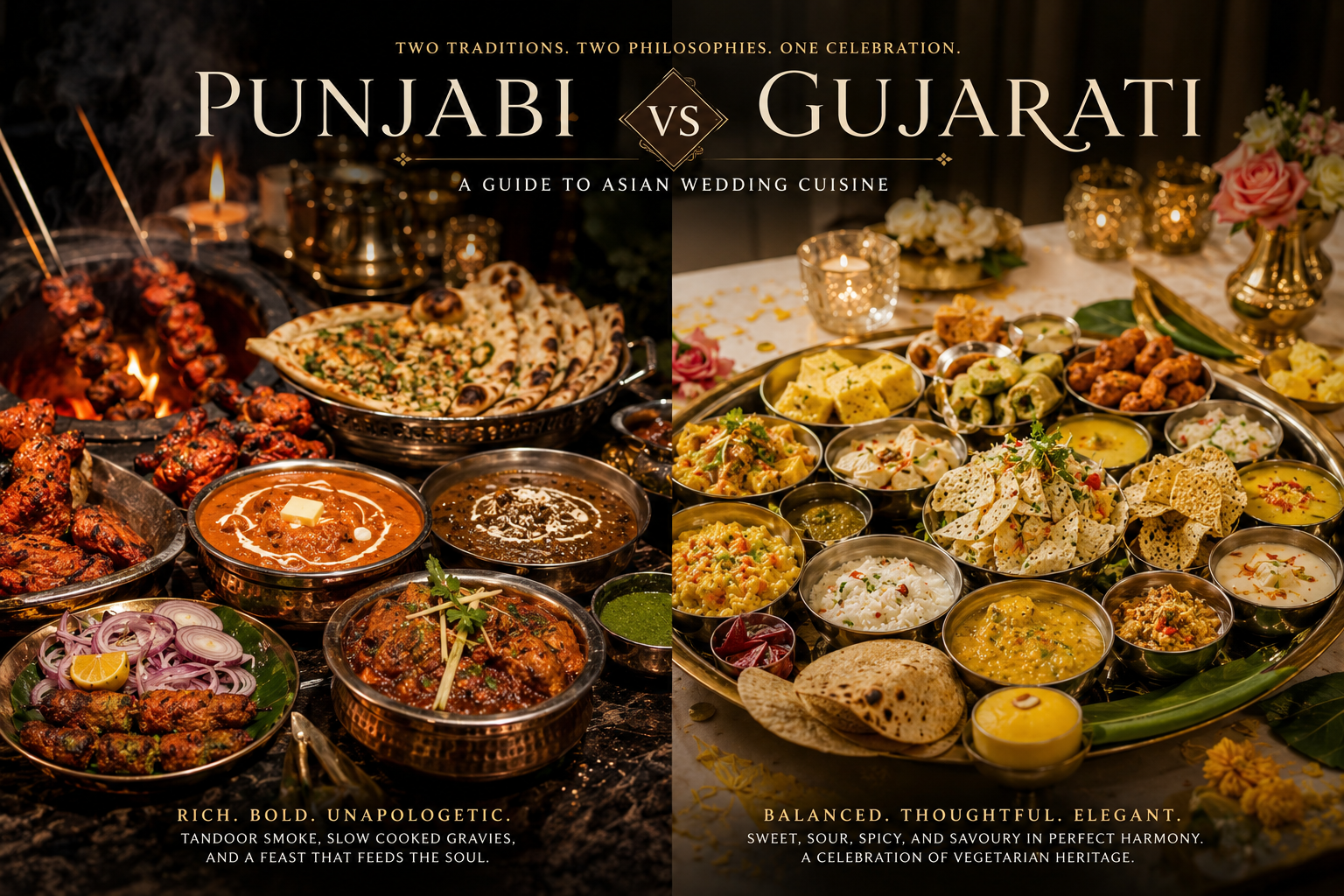
Punjabi or Gujarati Wedding Menu: A Side-by-Side Comparison of What’s on the Plate, and Why | The Clay Oven UK
If you’ve been to both a Punjabi wedding and a Gujarati wedding in the same month, you’ll know they’re not just different menus. They’re different philosophies about what a feast is supposed to do.
A Punjabi wedding feeds you like it’s daring you to leave hungry. There’s a swagger to it — tandoor smoke drifting across the marquee, butter melting into dal that’s been simmering since the night before, and someone’s uncle insisting you try just one more piece of seekh kebab. A Gujarati wedding, on the other hand, feeds you in waves. Small plates, sweet-savoury contrasts, a quiet pride in the fact that not a single dish on the table contains meat — and yet you’ll still be loosening your belt by the end of it.
After forty-odd years of catering both, we’ve come to think of it less as a comparison and more as a translation. So if you’re sitting down to plan your menu and trying to work out which way your wedding leans — or how to honour both sides of a mixed family — here’s how the two traditions actually differ on the plate, and the reasoning behind it.
Starters: The First Impression
Punjabi starters are loud. They’re meant to be. The starter round at a Punjabi reception is essentially a parade — tandoori chicken, paneer tikka, seekh kebabs, lamb chops, fish amritsari — all coming out hot off the coals, all unapologetically heavy. The logic is simple: guests have been drinking, the night is young, and you want them eating with their fingers and asking for seconds before the speeches even start.
Gujarati starters work differently. They lean on what’s called farsan — a category of snack that includes dhokla, khandvi, patra, fafda, samosas, kachoris and a dozen others depending on which part of Gujarat the family is from. Farsan isn’t really a “starter” in the Western sense. It’s something you graze on for an hour while people arrive, often with three or four different chutneys lined up beside it. The textures are doing the work — soft steamed dhokla against crisp fried fafda, the tang of green chutney against the sweetness of date-and-tamarind.
You can see the philosophy already: Punjabi food wants to dominate the room. Gujarati food wants to keep the conversation going.
The Mains: Where the Real Difference Lives
This is where the two cuisines diverge most sharply, and it has everything to do with history.
Punjab is dairy country. The cooking grew up around milk, ghee, paneer, cream and yoghurt, and it shows in every gravy. A proper Punjabi wedding main course will almost always include butter chicken or murgh makhani, dal makhani (the slow-cooked one, not the quick one), paneer in some rich tomato-cream gravy, and a meat curry with deep masala — lamb rogan josh, nihari, or a karahi. Breads come in volume: naan, kulcha, tandoori roti, all torn and shared.
The cooking technique itself matters here. The tandoor — that clay oven the country is named after, give or take — is the heart of a Punjabi menu. It’s why the kebabs taste the way they do, why the naan puffs the way it does, why even the paneer has a slight char to it. There’s no real substitute for it, which is why Punjabi catering done badly is so noticeably bad.
Gujarati mains take a completely different route. Most Gujarati wedding menus are entirely vegetarian — and that’s not a constraint, it’s the point. Gujarati cooking has spent centuries proving that you don’t need meat to feed a crowd properly. Expect undhiyu (a slow-cooked mixed vegetable dish that’s a whole event in itself), dal dhokli, sev tamatar nu shaak, ringan no olo, undhiyu, kadhi — and rotlis or thepla rather than naan.
There’s also a quiet sweetness running through Gujarati main courses that surprises people who haven’t tried it before. The dal will often have jaggery in it. The shaak will balance heat with a hint of sugar. It’s not dessert-sweet — it’s the kind of seasoning that makes everything taste more alive, the same way a pinch of salt does in baking.
The Sweet Course: Two Very Different Endings
Punjabi desserts go big. Gulab jamun in warm syrup, jalebi straight from the kadhai, kulfi in earthenware pots, gajar ka halwa in winter. The portions are unsubtle and the sweetness is unapologetic. A Punjabi sweet course is basically a victory lap.
Gujarati desserts, by contrast, are woven through the meal rather than served at the end. A traditional Gujarati thali will have shrikhand or basundi sitting alongside the savoury items, not after them. There’s mohanthal, ghari, sutarfeni, doodhpak — each one a slightly different play on milk, sugar, ghee and cardamom. The Gujarati instinct is that sweetness should accompany the meal, not interrupt it.
If you’re doing a mixed wedding, this is one of the most charming things you can do on the menu — serve a Gujarati-style sweet alongside the mains, then a Punjabi-style sweet at the end. Two traditions, one plate.
The Bit Nobody Talks About: Tempo
Here’s something we’ve learned that you won’t find in any menu pdf — Punjabi and Gujarati weddings are paced differently, and the food has to keep up.
A Punjabi wedding tends to peak late. People drink, dance, eat heavily, dance some more, and want a hot main course at 10pm. Which means your kitchen needs to hold the tandoor open longer, and your buffet needs to look as good at 10:45 as it did at 8:30.
A Gujarati wedding peaks earlier — often around the meal itself, which is treated as the main event of the evening. That means the food needs to land together, in proper sequence, with the farsan-shaak-dal-rice-sweet rhythm intact. Rushing a Gujarati menu is a way to ruin it. Slowing down a Punjabi one is a way to lose the room.
Most caterers who do one community well can’t do the other. The skill isn’t in the recipes — those are written down everywhere. The skill is in knowing when to bring out the kebabs and when to hold them back.
So Which One Suits Your Wedding?
Honestly, the answer is usually “both, in different proportions.” Most of the weddings we cater at our Wembley banqueting suites, at Denham Grove and at Hunton Park aren’t purely one or the other — they’re a Punjabi family marrying into a Gujarati family, or a couple who want to honour one tradition for the ceremony and the other for the reception.
If that’s where you are, our suggestion is simple: don’t water either menu down trying to make them blend. Let the Gujarati farsan do its job at the start, let the Punjabi tandoor take over at the main course, and finish with one sweet from each side. Done properly, your guests will remember the food long after they’ve forgotten the speeches.
And if you only have time for one piece of advice from forty years of doing this: never let anyone tell you a Gujarati menu is “lighter” than a Punjabi one. Eat through a proper undhiyu spread and we’ll see how light you feel afterwards.
The Clay Oven UK has been catering Punjabi, Gujarati and multicultural Asian weddings across London and the Home Counties since 1983. Our team works from our published Punjabi and Gujarati menus, but every wedding gets built around the family — not the other way around. If you’d like to talk through a menu for your day, get in touch with the team.