


Top 8 Indian Wedding Food Photographs You’ll Wish You Got — And How to Brief Your Photographer | The Clay Oven UK
A few months after every wedding, we tend to get the same message from a couple. “We just got our album back. We love it. But — we don’t have a single proper photo of the food.”
It’s the most consistent regret we hear. Three hundred guests, eight hours of celebration, fifty dishes prepared from scratch — and the photographer’s storage card comes back with a thousand frames of dancing, speeches and dressed-up cousins, and not one shot of the chaat station, the live tandoor or the dessert tower.
It’s not the photographer’s fault. Wedding photographers are trained to follow people. Most weddings they’ve shot have a cake, a sit-down dinner, and a buffet line that’s not much to look at. Nobody’s told them that at an Asian wedding, the food is a character — and that if they don’t shoot it deliberately, the moment is gone forever.
So here’s the brief we’d quietly slip your photographer if we could. Eight shots that, in our experience, are the ones couples wish they had — and how to set them up.
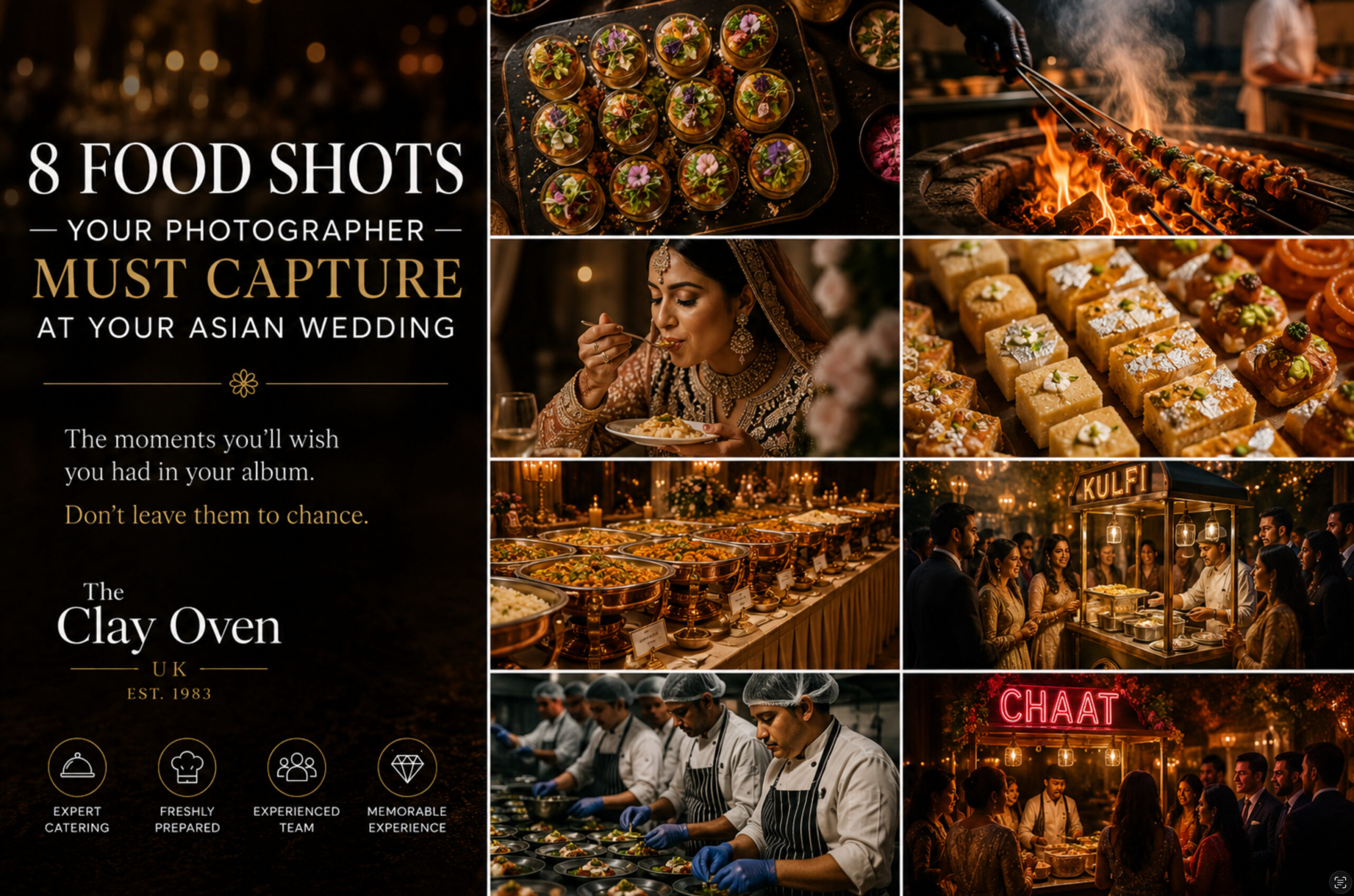
1. The chaat board overhead
Indian wedding canapés don’t look like Western ones. A chaat tasting board — twelve little glass cups, each one a different street food, microgreens and edible flowers across the top — is one of the most photogenic things a camera will ever land on. But only from directly above. Shot at an angle, it loses the geometry. Shot from above, it’s a magazine cover.
Brief your photographer: “There’s a chaat board going out in the first thirty minutes of the reception. I want a clean overhead shot, plates and board in frame, before any guests touch it. Two minutes, max.”
2. The tandoor flame, in motion
If your caterer is running a live tandoor station — and any good Asian wedding caterer will be — there is a single shot that absolutely has to happen. The chef pulls a skewer out of the tandoor. The flame is still licking the seekh kebab. The smoke is rising. The wood is glowing.
It happens for half a second. Then it’s gone.
Brief your photographer: “There’s a live tandoor station opening at [time]. The chef will be skewering kebabs continuously. I want one shot of the flame, mid-pull. You’ll need to stand close. Tell the chef you’re coming and they’ll time it for you.”
A good caterer’s chef knows exactly when their tandoor is going to flare. Ours will hold a skewer for an extra second if a photographer asks. We’ve done it dozens of times.
3. The bride’s first bite
Everyone photographs the bride and groom feeding each other cake. Almost nobody photographs the bride’s first proper bite of food at her own wedding.
It’s a private moment in the middle of a public day. She’ll have been running on adrenaline since 5am. The food finally arrives. She takes one bite. Her shoulders drop. Her eyes close for a second.
That’s the shot.
Brief your photographer: “When the bridal couple sit down to eat, give us ten minutes. Don’t pose us. Just be nearby with a long lens. I want the unposed first-bite shot.”
4. The mithai close-up
Indian sweets photograph beautifully and are almost never captured properly. Pistachio dust on barfi. The crystalline sugar shell on jalebi. The gold leaf on kaju katli. The deep amber colour of gulab jamun in syrup.
Shot well, the dessert table looks like a still life. Shot badly, it looks like a tray.
Brief your photographer: “Before the dessert table opens to guests, give it two minutes. Soft natural light if possible. Tight crops on the textures.”
5. The buffet line, just before it opens
There is a single, golden five-minute window at every Indian wedding when the buffet has been laid out, the chafing dishes have been polished, the garnishes are fresh, the labels are perfect — and nobody has touched it yet.
Five minutes later it’s a war zone. Five minutes after that, half of it’s gone.
That window is the one shot to remember the actual food by. It’s also the shot that a caterer (us included) genuinely values — because it’s how we show what we do to future couples.
Brief your photographer: “Find me five minutes before the buffet opens. Wide shot of the full spread, then a few tighter shots of individual dishes. The catering team will let you know exactly when it’s ready.”
6. The dessert tower or kulfi cart in full swing
If you’ve gone with a kulfi cart, a paan station, a mithai tower, a live jalebi vendor or any of the visually theatrical dessert add-ons — these are designed to be photographed.
But not empty.
The shot you want is during service. Guests gathered round. The vendor mid-pour. The cart at its busiest. Energy, not arrangement.
Brief your photographer: “There’s a [dessert station] opening around [time]. I want it shot during peak service, not before. Get the guests in frame, not just the food.”
7. The staff plating mid-service
This is the shot wedding photographers almost never take, and the one that gives the album its texture. The kitchen team in whites, behind the line, plating two hundred dinners with the precision of a military operation. Steam rising. Hands moving fast. The chef calling tickets.
It’s a documentary photograph. It tells the story of the work behind the day — the part the guests never see.
A photographer who’s never shot an Asian wedding before won’t think to ask for kitchen access. A good caterer will say yes the moment they’re asked.
Brief your photographer: “At some point during dinner service, the kitchen team will be plating in full swing. I’d love three or four shots from inside the kitchen — fast, in and out, no posed shots. Just the team working.”
(For what it’s worth — we always say yes to this. Most kitchens will. Ask early, not on the day.)
8. The late-night chaat counter
The wedding’s been going for six hours. The dancing’s stopped briefly. People are tired, mascara is smudged, ties are loosened. And then — at 11pm, just as the night gets its second wind — the late-night chaat counter opens.
It’s the moment of a wedding nobody plans to remember and everybody talks about for years afterwards.
A good photographer will already be packing up by this point. A great one will know to stay another twenty minutes.
Brief your photographer: “The late-night chaat counter opens around [time]. Even if you’re meant to wrap up before then — stay another twenty minutes. Some of the best photos of the night will be there.”
How to actually deliver the brief
Don’t tell your photographer all of this on the wedding morning. They’ll be running on too little sleep and too many timelines.
Send them this article — or a version of it — about a month before the wedding, when they’re still in the planning phase. They’ll bookmark it, they’ll thank you for it, and they’ll come to the day already half-prepared.
Then on the day itself, give your photographer just one person to coordinate with — your event manager, or the head of your catering team. We always nominate someone whose job it is to walk the photographer through the food moments as they happen. It saves the couple from having to think about it, and it saves the photographer from chasing the kitchen for information.
And one last thing
The food at your wedding will outlive your wedding day. Guests forget speeches. They half-remember songs. But they will, without fail, tell you for the rest of your life that the food at your wedding was the best food they’ve ever eaten at a wedding.
The photographs are how you remember that yourself. Don’t leave them to chance.
If you’d like to talk through the catering side of your day — or just want a kitchen team that knows how to time the tandoor flame for a photographer — we’d love to help. Forty years in, we’ve learned which moments matter. The food ones are usually first on the list.
You can reach the team at The Clay Oven UK.
The Clay Oven UK has been catering Asian weddings across London and the Home Counties since 1983. We own and operate three venues — in Wembley, Denham Grove and Hunton Park — and we’ve yet to refuse a photographer access to the kitchen.