


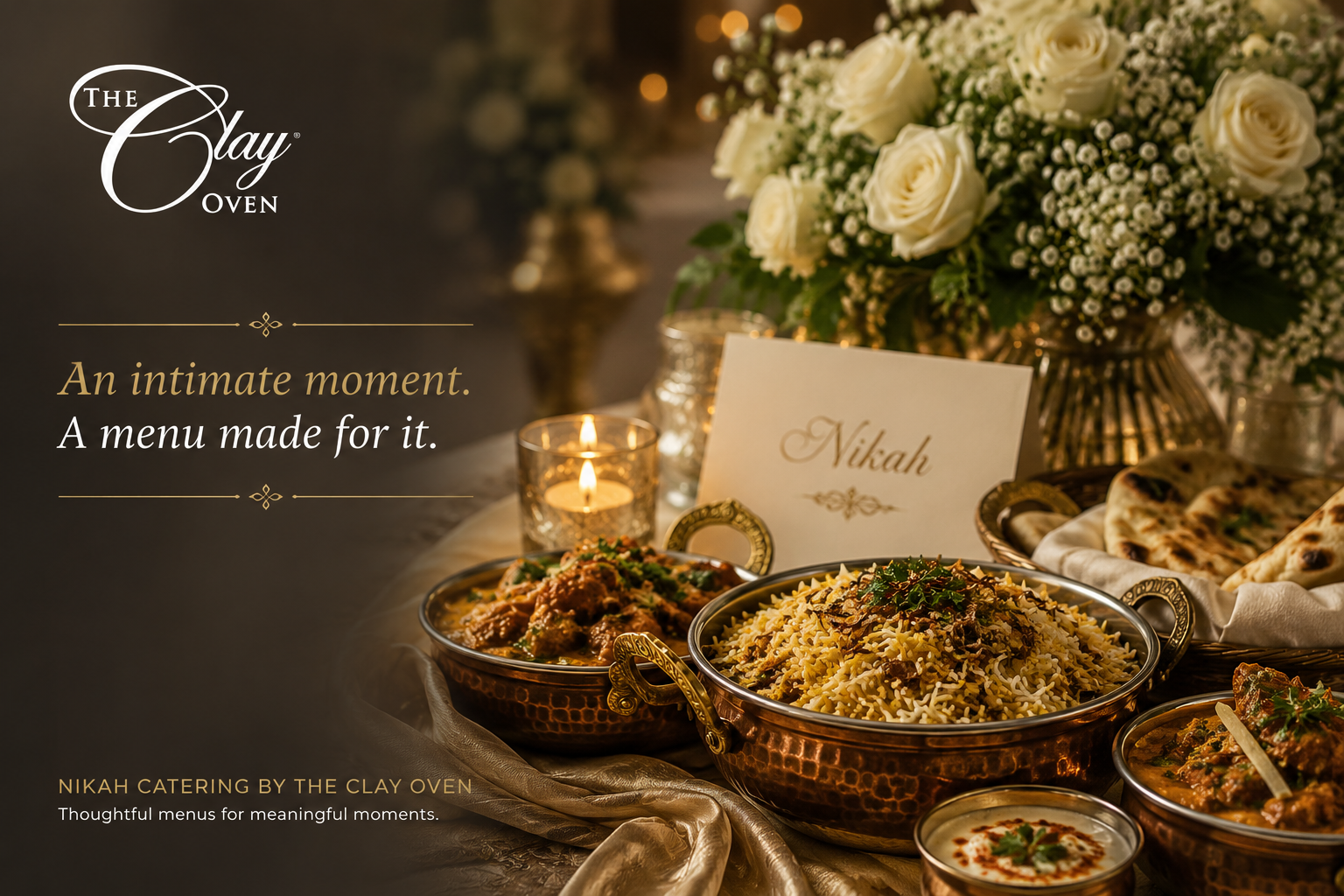
Nikah Catering in London: How The Clay Oven Plans the Menu for an Intimate Ceremony
A nikah is not a smaller version of a wedding reception. It has its own pace, its own meaning, and its own kind of guest list — usually closer family, often a quieter room, and a feeling that’s more personal than performative. So the food should not simply be a scaled-down banquet. It should be planned around what a nikah actually is.
At The Clay Oven, that’s the starting point for every nikah we cater: not “how many people,” but “what kind of moment is this.” This is how we think about the menu for an intimate ceremony, and what couples should consider before they book.
Why nikah catering is its own thing
The instinct many couples have is to take a full wedding menu and shrink it. It rarely works well. A large reception menu is designed for scale, movement and spectacle. A nikah is the opposite — it’s intimate, often seated, and the food is part of the warmth of the day rather than the entertainment.
That changes everything about how the menu should be built. With fewer guests and a closer setting, every dish is noticed. There’s nowhere for a weak dish to hide on a smaller table. So the priority shifts from variety for its own sake to quality, balance and dishes that genuinely suit the room. Fewer items, done beautifully, almost always lands better than a long buffet that overwhelms a small gathering.
How The Clay Oven approaches a nikah menu
We build a nikah menu around three simple questions, and they matter more than any set package.
First, what’s the timing of the ceremony? A morning or early-afternoon nikah calls for something different from an evening one. A daytime ceremony often suits a lighter, fresher menu — grilled starters, lighter curries, fragrant rice — while an evening nikah can carry a richer, more celebratory spread. Matching the food to the hour is one of the easiest ways to make a small event feel considered rather than generic.
Second, who is actually in the room? A nikah of forty close relatives is catered very differently from one of a hundred and fifty. With a smaller, family-heavy guest list, we lean toward dishes that feel personal and familiar — the food families actually love rather than what looks impressive on a banquet table. Where there are elders, children, or specific dietary needs, a smaller event makes it far easier to look after everyone properly, and we plan for that from the start.
Third, is the nikah standalone, or part of a larger day? A nikah followed later by a walima or reception should be catered so the two don’t repeat each other. Nobody wants the same menu twice in one celebration. We deliberately design the nikah food to feel distinct from whatever comes after it, so each event has its own identity.
What works well on an intimate nikah menu
For smaller, more personal ceremonies, the menus that consistently work share a few qualities. They open with a small, sharp selection of starters rather than a sprawling one — a couple of well-chosen grilled or tandoori options and a vegetarian highlight do more than ten lukewarm canapés. The mains stay focused: a balanced choice across meat and vegetarian, with rice and fresh breads, built so the table feels generous without being excessive.
And the sweet course earns real attention. At an intimate gathering, dessert is often the moment people linger over and remember, so it deserves more thought than being an afterthought tray. A considered dessert — whether traditional mithai done well or a more contemporary sweet course — is one of the details guests quietly carry home with them.
Throughout, the principle is the same: at a nikah, restraint is not a compromise. A tighter, well-judged menu reads as care, not as cutting back.
Halal, dietary needs and getting it right
For a nikah, getting the fundamentals unmistakably right matters more than any flourish. That means halal handled properly and without ambiguity, clear labelling where guests need it, and dishes prepared so that elders and children are looked after as thoughtfully as everyone else. A smaller event is actually the easiest place to do this well — there’s room to be precise — and precision is exactly what families notice and appreciate on a day this meaningful.
If you have specific requirements, the right time to raise them is at the very first conversation, not after the menu is set. A good caterer will build the menu around those needs from the beginning rather than working around them later.
A few things worth deciding before you book
Before approaching any caterer for a nikah, it helps to be clear on a few things, because they shape every recommendation that follows. Know your rough guest number and how close-knit the group is. Know the time of day. Know whether the nikah stands alone or sits within a larger sequence of events. And have a sense of the feeling you want the day to have — calm and traditional, warm and family-led, or quietly elegant. The clearer you are on these, the more tailored — and the more yours — the menu can be.
The Clay Oven approach, in one line
A nikah is an intimate moment, and the food should feel like it was planned for that moment specifically — not borrowed from a bigger event and made smaller. That’s the standard we hold every nikah menu to: fewer dishes if needed, but every one of them chosen with intent.
The Clay Oven caters nikah ceremonies, walimas and weddings across London, with menus built around the size, timing and spirit of your day — fully halal and tailored to your families. Speak to The Clay Oven to start planning your nikah menu.