


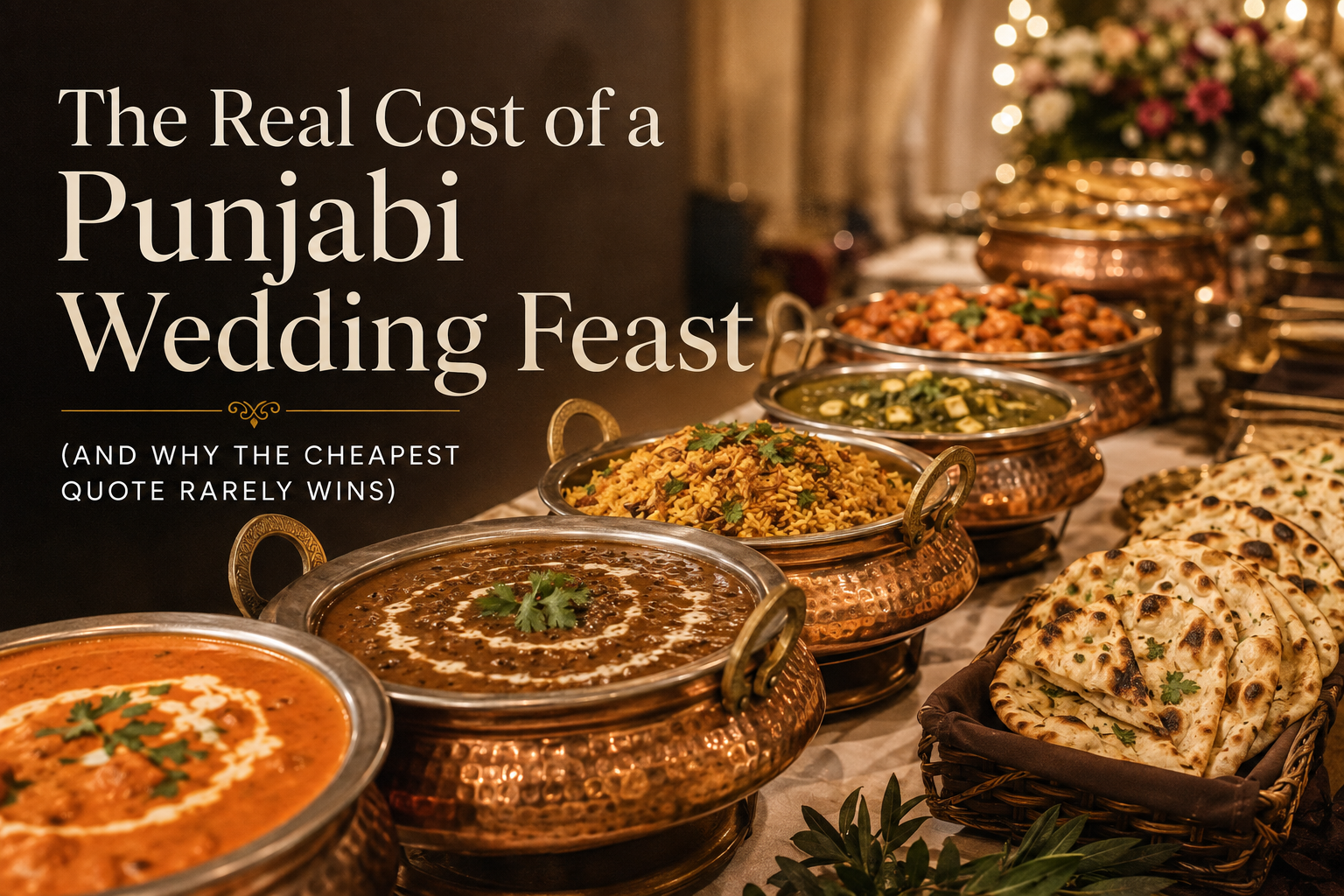
The Real Cost of a Punjabi Wedding Feast (And Why the Cheapest Quote Rarely Wins)
Three quotes land in your inbox for the same guest count, the same date, roughly the same menu on paper — and the prices are miles apart. One caterer is £20 a head cheaper than the other two. It’s tempting. It’s also usually the moment where a lot of Punjabi weddings quietly go wrong.
Punjabi wedding feasts are not a fixed-price product. The final number on your invoice is the result of dozens of small decisions — how the dal is cooked, how many chefs are on shift, whether the naan comes from a tandoor or a warming tray — and most families never find out which decisions their caterer made until the day itself. Here’s what actually drives the cost, and why the cheapest quote is rarely the smartest one.
What You’re Actually Paying For
A Punjabi wedding menu looks deceptively simple on a price list — butter chicken, dal makhani, saag, a couple of kebabs, rice, naan. What separates a £45-a-head menu from a £95-a-head menu almost never shows up as a line item. It’s in:
- Ingredient quality and freshness — slow-cooked dal made from scratch that morning versus a bulk-prepped batch reheated on the day
- Chef-to-guest ratio — a proper Punjabi feast needs chefs actively cooking through service, not just plating pre-made trays
- Live cooking elements — a tandoor station cooking naan and kebabs to order costs significantly more in labour and equipment than pre-cooked trays kept warm
- Portion generosity and re-fills — whether your buffet is genuinely restocked through the evening or quietly runs thin after the first sitting
- Front-of-house service — trained waiting staff versus a skeleton crew clearing plates
- Venue logistics — cooking on-site in a proper kitchen versus catering delivered cold and reheated in a marquee
None of this is visible on a quote sheet. It only becomes visible on the day — which is exactly the problem.
Why the Cheapest Quote Rarely Wins
A lowball quote isn’t usually a caterer being generous. It’s usually one (or several) of these corners being cut:
- Smaller chef teams working faster, not better — corners get cut on technique to hit volume, and dishes that should be slow-cooked get rushed
- Bulk-prepped food reheated on the day — cheaper to produce, but it shows in texture and flavour, especially in dal, curries, and anything with a gravy base
- Thinner portions with no real re-fill plan — fine for the first 100 guests through the buffet, less fine for the last 50
- Hidden extras added later — service charge, delivery, equipment hire, or staffing costs that weren’t in the original per-head number
- Inexperienced or agency waiting staff — cheaper by the hour, but it shows in how smoothly the evening runs
The family rarely finds out which of these happened until the wedding is already underway — at which point there’s nothing to be done about it.
Questions That Actually Tell You What You’re Paying For
Instead of comparing the bottom-line number, ask every caterer the same set of questions and compare the answers:
- Is the per-head price fully inclusive, or are staffing, service charge, and equipment hire added separately?
- Will the food be cooked on-site, or prepared off-site and transported?
- What’s your chef-to-guest ratio for a wedding this size?
- Is the buffet actively restocked through service, or set out once?
- Can we taste the actual dishes being served, not a sample menu?
A caterer confident in their pricing will answer these clearly and immediately. Vague answers are usually where the real cost difference is hiding.
What a Fair Punjabi Wedding Catering Price Actually Reflects
Pricing for a proper Punjabi feast in London generally scales with three things: guest count, how much of the menu is live-cooked versus pre-prepared, and whether your caterer is also managing the venue and event logistics. A caterer who owns their own kitchens and venues — rather than subcontracting or delivering cold food into a rented space — is often able to offer better value at a comparable price point, simply because there’s no middleman markup and no logistics risk baked into the number.
This is also where experience matters more than most families expect. A caterer who’s cooked thousands of Punjabi weddings knows exactly how much dal, how many kebabs, and how much naan a given guest count actually needs — which means fewer expensive last-minute top-ups and less wasted food, both of which affect the final bill either way.
The Real Question to Ask Yourself
The lowest quote and the best value are rarely the same number. Before you sign with the cheapest option, ask what’s been left out to hit that price — because on a Punjabi wedding day, with a hundred elders expecting the dal to taste like it should, that’s not a corner most families want cut.
At The Clay Oven, our Punjabi wedding menus are cooked on-site by chefs who’ve been doing this since 1983 — no reheated trays, no subcontracted kitchens. Get in touch for a transparent, fully-inclusive quote for your guest count.