


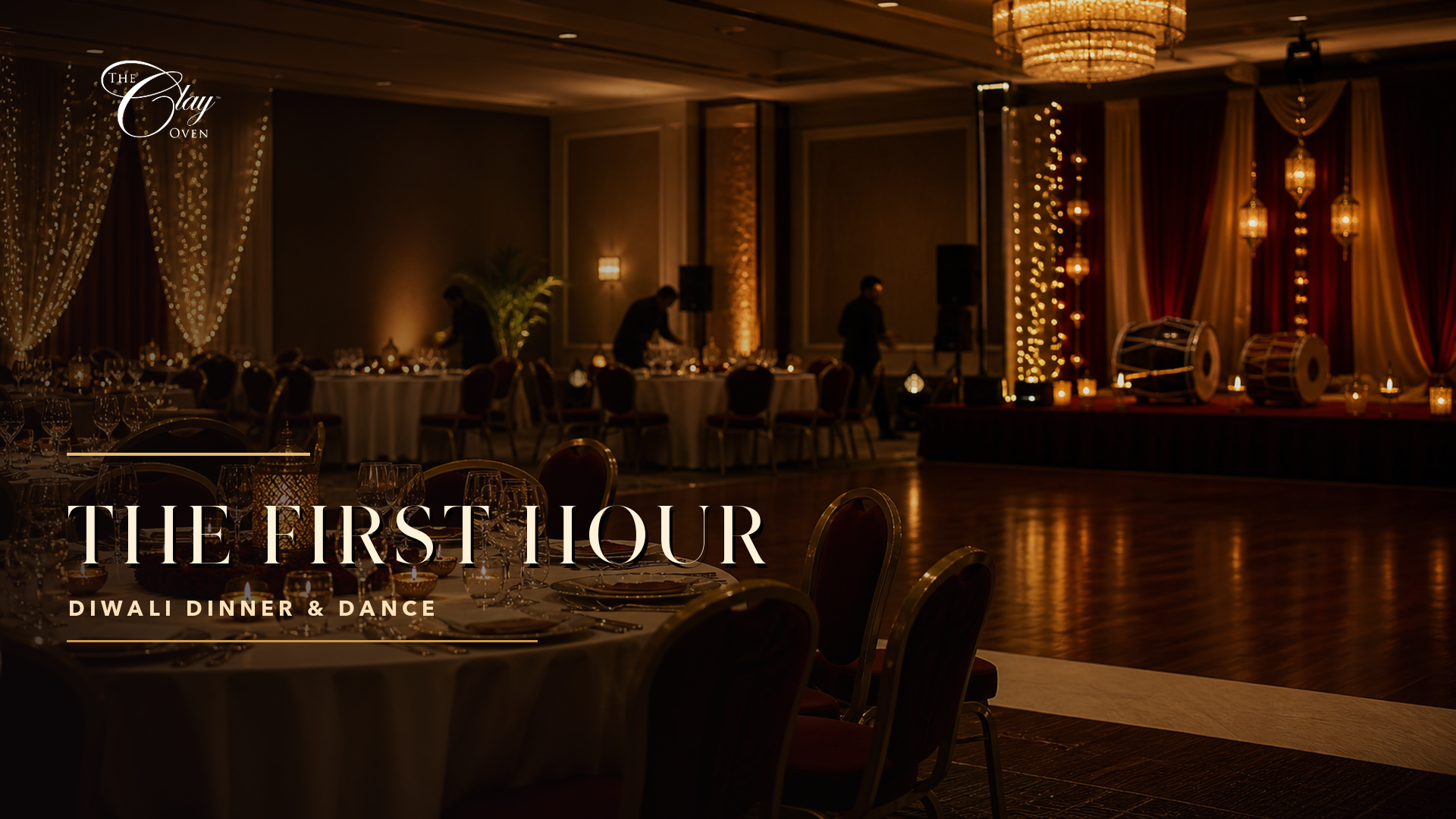
Inside a Diwali Dinner & Dance at The Clay Oven: What the First Hour Feels Like
There is a specific kind of quiet that exists in the ten minutes before an event starts. Not silence — the room is far from silent — but a held-breath quality that settles over a space when everyone knows something good is about to happen and nobody wants to be the one still finding their seat when it does.
At The Clay Oven’s Diwali Dinner & Dance, that quiet lasts almost exactly as long as it takes the first fairy light to catch someone’s eye at the entrance. After that, the evening simply takes over.
This is what the first hour actually feels like, from the moment you step through the door to the moment the room properly comes alive.
6:00pm — The Room Before It Fills
The doors open at six, and for the first fifteen minutes or so, the room belongs almost entirely to the people who arrived early — the couples who like to get settled before anyone else turns up, the friend groups who agreed to meet promptly for once, the families who brought their parents and know better than to cut it fine.
Walking in at this point, you notice things you would miss later once the room is full and loud. The way the lighting has been set low and warm, gold rather than white, so that everything it touches — the tablecloths, the small diyas placed along the tables, the metallic thread running through half the outfits in the room — catches and holds a little glow. The faint, unmistakable smell of a professional kitchen already working hard somewhere behind the scenes, spice and warmth drifting out before a single plate has been served. Somewhere, a member of the entertainment team is doing a final soundcheck, a burst of dhol rhythm cutting through for two seconds before it stops again.
There is a stillness to this part of the evening that most people never really register, because by the time they arrive themselves, it has usually already passed. But it matters. It is the moment when a room that has been set up all afternoon finally starts to feel like an event rather than a space.
6:15pm — Arrivals Begin in Earnest
Then, quite suddenly, everyone arrives at once.
This is the part of the evening that has its own particular choreography, even if nobody involved would describe it that way. Coats are handed over. Names are found on table plans, or groups simply claim the seats they like the look of. Someone spots a cousin they haven’t seen since the last wedding and there’s a brief, delighted commotion by the entrance before both parties peel off toward their respective tables. Phones come out — not to check messages, but to capture the room itself, the decor, the outfit someone’s mother spent three weeks deciding on.
The outfits, if you’re paying attention, tell their own story about the evening ahead. This is not a night people dress down for. Sarees in deep jewel tones sit beside sharply tailored sherwanis. Younger guests arrive in a mix of traditional and contemporary — a lehenga paired with trainers, a kurta worn open over a plain white t-shirt — the kind of styling that only really happens at events where several generations are dressing for the same room but according to slightly different rules.
By 6:30, the room has gone from quiet to properly buzzing, though the volume is still conversational rather than celebratory. That shift comes later. Right now, it’s catching up, laughing, settling in — the low hum of a few hundred people who all know each other, or almost all know someone who knows someone, doing what British Punjabi and Gujarati families do best: turning strangers-of-friends into instant familiarity within about four minutes flat.
6:45pm — The First Plates
Just as the room properly fills, the pre-starters arrive — Samosa Chaat and Chilli Garlic Mogo moving out from the kitchen in that particular rhythm that experienced catering teams manage without seeming to try. Nothing rushed, nothing delayed, just a steady, well-timed flow that means nobody is left waiting and nobody feels like they’ve missed the start.
There’s something specific about the way people eat at this stage of the evening — unhurried, still mid-conversation, plates balanced somewhat precariously while someone finishes telling a story. The samosa chaat, with its crushed pastry and chickpeas and sharp tang of chutney, is the kind of dish built for exactly this moment: easy to eat one-handed, punchy enough to properly wake up the appetite, and good enough that it briefly interrupts even the most engaged conversation while someone takes a second to actually taste what they’re eating.
This is also, if you’re watching the room rather than your plate, when you start to notice the shape of the evening beginning to form. The DJ has quietly taken up position. A couple of the younger guests have already claimed a spot near what will become the dance floor, standing slightly too close to it for anyone who isn’t planning to be first up when the music properly starts. And somewhere near the back, the dhol players are doing exactly what dhol players always seem to do in the minutes before they perform — standing loosely together, drums resting against hips, radiating the specific calm of people who know precisely how the next hour is about to change.
7:00pm — The Turn
If there is a single moment when a Diwali Dinner & Dance stops being a very nice dinner and starts being a genuine party, it happens somewhere around here.
It rarely announces itself cleanly. There’s no dramatic cue, no sudden blackout followed by a spotlight. Instead, it tends to happen the way these things always do — the dhol starts up, not loudly at first, just a rhythm threading its way under the existing chatter, and within about thirty seconds, half the room has stopped talking and started watching. A few people are up on their feet before the beat has even properly established itself, because if you’ve grown up around a dhol player, some part of you responds to that sound before your brain has caught up.
Watching this moment happen, year after year, event after event, never quite gets old, because it never plays out exactly the same way twice. Sometimes it’s a group of aunties who get up first, completely unbothered by anyone watching, dancing with the particular unselfconscious joy that only comes with decades of practice at exactly this kind of celebration. Sometimes it’s the youngest guests in the room, dragging slightly more reluctant parents up alongside them. Sometimes — often, actually — it’s everyone at once, as if the whole room had been quietly waiting for permission and the dhol just gave it to them.
By ten past seven, the starters buffet has opened alongside all of this — Murg Malai Tikka, Seekh Kebab, Palak Patta Chaat, Chilli Paneer, Hara Bhara Kebab, laid out and ready — and there’s a wonderful, slightly chaotic overlap where half the room is dancing and the other half is queuing for food, and both groups seem completely satisfied with their choice. Nobody is rushing anyone off the dance floor to eat. Nobody at the buffet feels like they’re missing anything by not dancing yet. The evening has room for both, because that’s really the entire point of a proper Dinner & Dance — it was never meant to be one or the other.
What the First Hour Actually Tells You
If you have never been to one of these evenings before and you’re trying to decide whether it’s worth going, the truest answer is probably this: the first hour tells you almost everything you need to know about the rest of the night.
If the room fills with that particular warmth — the fairy lights catching the right way, the smell of proper cooking drifting from the kitchen, the dhol arriving at exactly the moment the room is ready for it, the food good enough that people stop talking mid-sentence to actually taste it — then everything that follows tends to simply build on that foundation. The dancing gets bigger. The main course lands at exactly the right point in the evening, when appetites have properly returned after an hour of movement. The night stretches out in front of you, five hours that somehow manage to feel like both no time at all and exactly the right amount.
That’s really what a Diwali Dinner & Dance is meant to be. Not a dinner with some entertainment attached, and not a party that happens to serve food. Something that sits properly in between — where the food matters as much as the music, and the first hour sets a tone that the rest of the evening simply lives up to.