


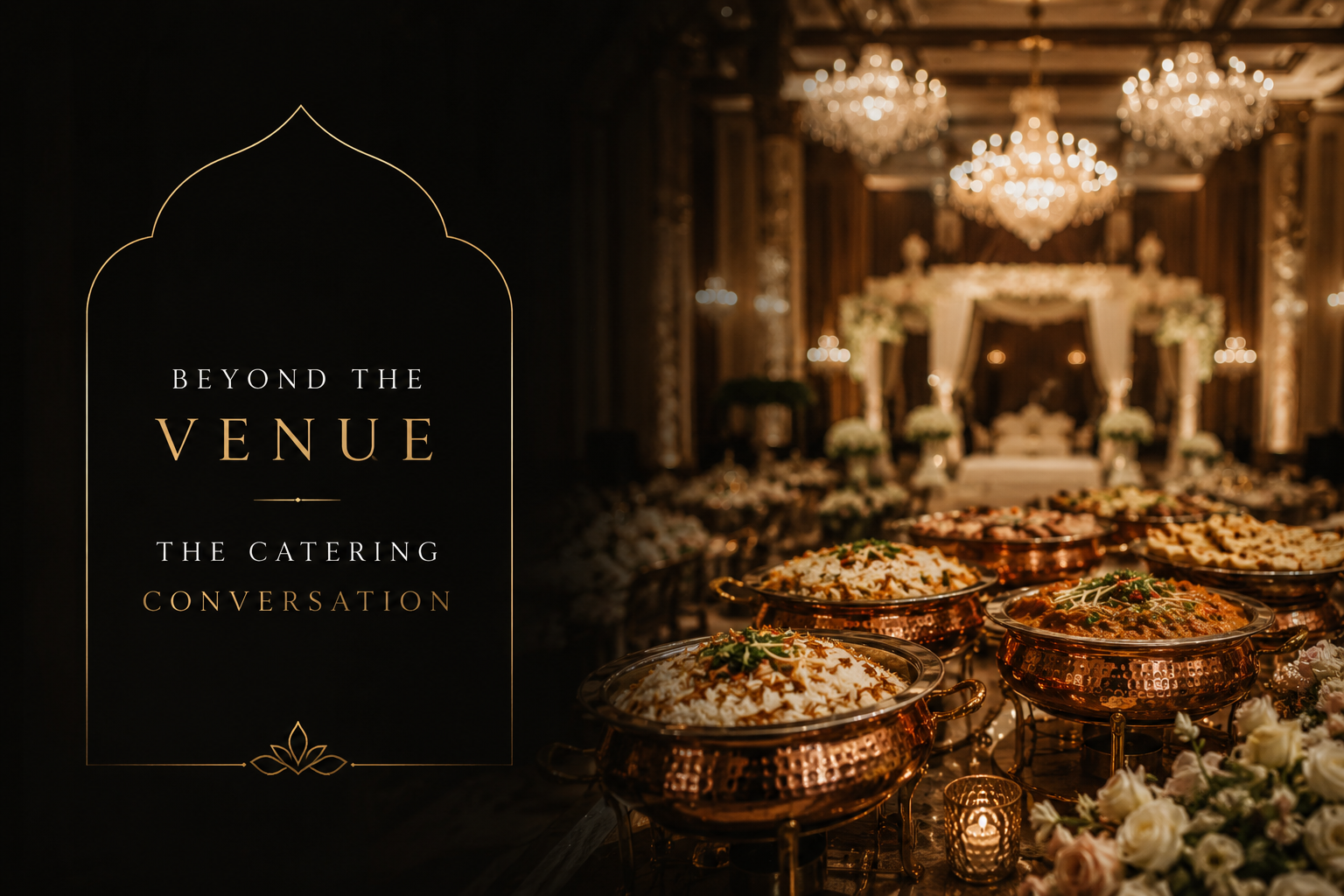
Dry Hire vs Full Service: What “Approved Caterer” Lists Really Mean at UK Wedding Venues
Somewhere between falling in love with a venue and signing the contract, almost every couple planning an Asian wedding in the UK runs into a sentence that stops them in their tracks. It usually appears on page two or three of the hire pack, in slightly smaller type than the rest of the document, and it reads something like this: “Catering must be arranged through one of our approved suppliers.”
For most couples, that line is the first time they realise their wedding venue is not actually offering them a venue at all. It is offering them a venue and a list of people they are allowed to choose from to feed their guests. And depending on which list that is, and which terms attach to it, the implications for the kind of wedding they can actually have are considerable.
After over forty years catering at hundreds of venues across London and the wider UK — from our own banqueting suites in Wembley to country house estates, historic palaces and West End hotels — The Clay Oven has worked under every model the British wedding venue industry currently operates. And in our experience, very few couples are given a proper explanation of what these different models actually mean, what they cost, and where the trade-offs lie. So this is that explanation.
Three Models, One Industry, Very Different Outcomes
UK wedding venues broadly operate under three different catering models, and understanding the difference between them is the single most important piece of due diligence a couple can do before they pay a venue deposit.
The first model is the in-house caterer. The venue owns or directly employs its catering team. You hire the venue, you eat the venue’s food. There is no choice in the matter, and the catering cost is usually built into the per-head package.
The second is the dry hire venue. The venue gives you the space and nothing else. The catering, the bar, the equipment, the staff — all of it is your responsibility to arrange. You bring in the caterer of your choice, subject only to standard insurance and food safety requirements.
The third, and by far the most common in the premium British wedding market, is the approved caterer list model. The venue provides the space but requires you to select your caterer from a pre-vetted list that the venue itself controls. And within this category, there are two important sub-categories — recommended lists, which are advisory, and exclusive lists, which are mandatory. The difference between those two words can determine whether your wedding looks the way you imagined it or doesn’t.
For couples planning an Asian wedding, this matters in ways that couples planning a Western wedding don’t always have to think about. The kind of catering an Asian wedding requires — the volumes, the specific cuisines, the religious requirements, the multi-day event structure — is not something every venue’s approved supplier can deliver competently. The list you are being handed may not have a single caterer on it who has actually catered a Sikh wedding for five hundred guests, or a Gujarati reception with a full Jain dietary protocol, or a Tamil ceremony that runs from breakfast through to a late evening reception.
What “Approved Caterer” Actually Means
When a venue tells you they have an approved caterer list, what they are really telling you is several things at once.
They are telling you that they have a commercial relationship with a small group of caterers, and that those caterers have agreed to certain standards, certain insurance levels, certain operating protocols, and — often, though not always disclosed openly — certain financial arrangements with the venue itself. Commission, referral fees, marketing contributions. These are standard industry practice and not necessarily problematic. But they are real, and they shape the list you are given.
They are telling you that the caterers on that list have catered at the venue before, know the kitchen layout, understand the access points, the loading times, the parking restrictions, the noise regulations, and the operational quirks of the building. This is genuine value. A caterer who has worked at Syon Park or the Waldorf Hilton fifty times moves differently on the day than one who is seeing it for the first time.
And they are telling you, implicitly, that any caterer not on the list is going to be either prohibited, restricted, or made more difficult and expensive to bring in. Sometimes a venue will allow an external caterer on payment of a fee — often called a “kitchen hire charge” or “external supplier surcharge” — that can run anywhere from £1,500 to £5,000 or more depending on the venue. Sometimes they will refuse altogether.
For Asian wedding catering in London specifically, the list you are handed at a five-star venue may contain three or four catering companies, of whom one or two might have genuine Asian wedding experience, and the others may treat your enquiry as an opportunity to learn. That is the polite way of putting it.
Recommended Lists vs Exclusive Lists: The Difference That Matters
The wording on a venue’s catering policy is worth reading very carefully, because the same phrase can mean very different things depending on how it is constructed.
A recommended caterer list — sometimes called a preferred supplier list — is advisory. The venue is telling you which caterers they like working with, which ones they trust, and which ones they think will do a good job. But you are not obligated to choose from that list. You can bring in your own caterer, though usually subject to some conditions and sometimes an additional charge.
An exclusive caterer list — sometimes phrased as “all catering must be provided by an approved supplier” — is mandatory. There is no flexibility. The list is the menu of who you are allowed to hire.
Then there is a third variant which is increasingly common at high-end UK venues, and which often confuses couples — the sole supplier or single approved caterer arrangement. Here, the venue has one exclusive catering partner, and that is the only catering option available. No list. Just the partner.
For Asian wedding planning, the distinction is fundamental. A venue with a recommended list of British catering companies might still be a brilliant choice for your wedding, because you can bring The Clay Oven in as an external caterer and the venue will work with us. A venue with an exclusive list that contains no genuine Asian wedding caterer is — bluntly — a venue that is going to constrain what your wedding can be, no matter how beautiful the photographs of it look.
This is the conversation that needs to happen during the venue viewing, not after the deposit is paid. The wording matters. And so does the willingness of the venue to be flexible if you push the question.
Why Venues Operate This Way
It is worth understanding the venue’s perspective, because the approved caterer model exists for reasons that are not purely commercial — though commercial reasons are part of it.
A wedding venue is responsible, legally and reputationally, for what happens inside its walls. If a caterer it has never worked with arrives on the morning of a wedding, sets up in an unfamiliar kitchen, runs a service that the venue’s operations team has not seen before, and something goes wrong — food safety, timing, fire regulations, equipment damage, guest illness — the venue is the one whose name is attached to it. Approved supplier lists exist, in part, to manage that risk. The venue knows the caterer. The caterer knows the venue. There is institutional memory on both sides.
There is also the practical question of operational compatibility. Premium UK wedding venues frequently have demanding kitchen setups — limited gas capacity, restricted access windows, specific waste disposal protocols, fire suppression systems that need to be respected, dance floors and lighting rigs that need to be worked around. A caterer who has never operated in a building like that, attempting to deliver dinner for four hundred guests at a fixed time, is taking a risk the venue would rather not authorise.
And yes, there is the commercial dimension. Venues earn a margin on catering. Either through commission arrangements with approved suppliers, or through kitchen hire fees from external caterers, or through the direct margins on in-house catering. This is how the industry funds itself, and it is not unique to weddings. But it does mean the approved supplier list is also, in part, a commercial instrument — and couples should understand that when they are reading one.
What This Means for Asian Weddings Specifically
The approved caterer model can be a particular issue for couples planning an Asian wedding in London, and the reason is straightforward. Asian wedding catering is a specialised discipline. The scale, the cuisine, the cultural and religious requirements, the multi-day event structure — none of these are things a generalist British catering company can deliver to the standard that families with deep traditions expect.
If you walk into a five-star London venue, fall in love with the ballroom, and accept their exclusive caterer list without checking what is on it, there is a real chance you will end up with a wedding caterer who has produced a “Curry Night” once before and is treating your event as an interesting brief. The food will be edible. The guests will eat it. But the aunties will know. And so will you.
This is why the most experienced Asian wedding caterers in the UK — The Clay Oven among them — work hard to be listed at the venues where Asian couples actually want to get married. We are on the approved supplier lists at Syon Park, the Waldorf Hilton, 8 Northumberland, the East Midlands Conference Centre, Millennium Gloucester, Oatlands Park Hotel, Radisson Edwardian and others. That listing is not automatic. It is earned through years of consistent delivery, professional relationships, and the operational track record that venues require before they will put a caterer’s name in front of their clients.
It also means that when a couple comes to us having already booked one of these venues, we can step in and operate seamlessly, because we already know the building, the kitchen, the team, and the protocols. That is a meaningful advantage on a day where the margin for error is small.
The Dry Hire Option — More Freedom, More Responsibility
For couples who want maximum control over their wedding catering and feel constrained by approved supplier lists, the dry hire model is increasingly attractive — and increasingly common in the UK.
A dry hire wedding venue offers you the space alone. You arrange the catering, the bar, the staff, the furniture if needed, the equipment, the cleaning, the everything. The venue provides the four walls (or sometimes just the field) and a set of operational rules. The rest is yours.
The advantage is obvious. You can bring in The Clay Oven, or any other caterer of your choice, with no list restrictions and no kitchen hire surcharge. You can design the menu, the service style, the live stations, the canapé selection and the dessert presentation exactly as you want them. For an Asian wedding, where the catering is often the cultural and emotional centrepiece of the event, this freedom is genuinely valuable.
The trade-off is the workload. Dry hire venues require you to coordinate everything — and “everything” at an Asian wedding is a large category. You will need to think about kitchen infrastructure (does the venue have a working catering kitchen, or will the caterer need to set up a field kitchen?), power supply, water access, refrigeration, waste disposal, parking for staff, loading windows, licensing for the bar, and a dozen other operational questions that an in-house venue would simply absorb.
For couples working with an experienced Asian wedding caterer, this workload is manageable — because the caterer absorbs most of it. The Clay Oven has catered weddings at dry hire venues across the South East and beyond, and we have seen what works and what doesn’t. The right dry hire venue with the right caterer can produce a wedding that is genuinely unrepeatable in any other format. The wrong one can produce a long, expensive day with too many things going wrong in parallel.
The honest summary is this: dry hire is a wonderful option for couples who want creative control and who have an experienced catering partner who can carry the operational weight. It is a difficult option for couples who pick a beautiful field, assume the rest will sort itself out, and then discover in week six of planning that nobody has thought about where the staff are going to wash up.
Our Own Model: Why The Clay Oven Operates Differently
The reason The Clay Oven owns its own venues — The Clay Oven Banqueting Suites in Wembley, Denham Grove in Buckinghamshire and Hunton Park in Hertfordshire — is precisely because we have spent forty years watching couples navigate the approved caterer question, and we understand the value of a single relationship that covers both venue and catering.
When a family books one of our own venues, there is no approved supplier list to negotiate, no external caterer surcharge to budget for, no question of whether the catering team has worked in the kitchen before. We are the catering team, and the kitchen is ours. The venue and the food are designed around each other, which is a different proposition entirely from a venue that has bolted catering onto its operation as an afterthought.
But we also know that not every couple wants to get married in a Wembley banqueting suite or a Buckinghamshire country house. Some couples have their heart set on Syon Park, or the Waldorf Hilton, or the East Midlands Conference Centre, or one of the many other venues across the UK where we are an approved supplier. And that is fine. What matters is that the couple understands the catering structure of the venue they are booking, asks the right questions before they sign, and chooses a caterer who can deliver the wedding they actually want — not the wedding the venue’s default list happens to allow.
The Questions to Ask Before You Book Your Venue
To make this practically useful, here are the questions every couple planning an Asian wedding in the UK should be asking before they pay a venue deposit.
Is your catering in-house, dry hire, recommended list, or exclusive list?
If there is a list, who is on it? Can I see the names before I book?
How many of the caterers on your list have catered Asian weddings of my size? Can you give me references?
If I want to bring in an external caterer, is it permitted, and what is the additional charge?
What kitchen infrastructure is available — gas, electric, refrigeration, prep space, water?
What are the access and loading windows for catering teams?
Are there any restrictions on cooking equipment, live stations, or specific cuisines?
What is the venue’s policy on dietary requirements — halal, Jain, vegan, allergen protocols?
A venue that answers these questions clearly and directly is a venue you can plan a wedding at. A venue that hedges, deflects or gets evasive is telling you something important about how the wedding day itself is going to feel.
Why Couples Come to The Clay Oven
The Clay Oven has been catering Asian weddings, religious ceremonies, corporate events and large-scale celebrations across London and the UK for over forty years. We operate as an in-house caterer at our own three venues, as an approved supplier at many of the country’s most prestigious wedding locations, and as an external caterer at dry hire venues from the Cotswolds to the Surrey hills.
That breadth of experience means we can have a real conversation with couples about which model suits their wedding best — not the model that suits us. Sometimes the right answer is one of our own venues. Sometimes it is a hotel where we are already an approved caterer. Sometimes it is a dry hire estate where we will set up a full field operation and run the entire event from scratch.
What matters is that the conversation happens at the start of the planning process, not in week six when the constraints become inconvenient. And the family deserves a caterer who is honest about which option will actually deliver the wedding they are imagining — even when that honesty means recommending a path that isn’t the simplest one for the caterer to operate.
That is the conversation we have been having with families for four decades. And it is the one we would be glad to have with yours.
To discuss your wedding catering, our venues, or any of the partner venues where The Clay Oven is an approved supplier, speak to our team on 020 8903 8800 or visit theclayoven.co.uk/contact.