

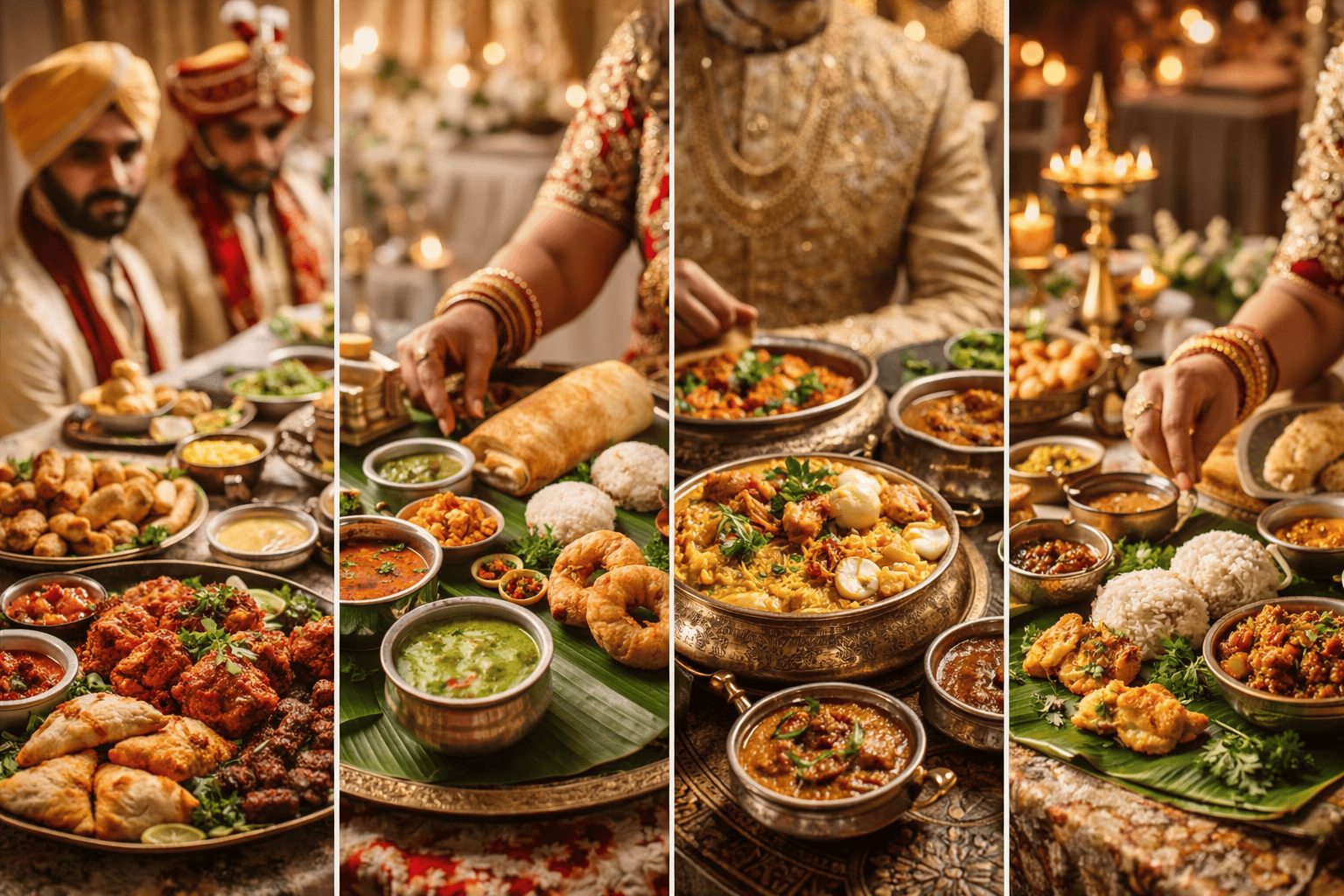
Hindu, Muslim, Sikh, Tamil, Sri Lankan: Why One-Size-Fits-All Asian Catering Is a Myth
Here is something the catering industry does not say often enough: “Asian wedding catering” is not a category. It is a continent.
When a couple books an “Asian caterer” without asking the right questions, they are assuming that the person on the other end of that conversation understands the difference between a Hindu wedding menu and a Muslim one, between South Indian wedding food and Punjabi wedding food, between what a Sri Lankan family expects at a reception and what a Bengali family considers non-negotiable.
Sometimes that assumption is correct. Often, it is not. And the difference between the two outcomes shows up on the plate, in front of three hundred people, on a day you cannot repeat.
The Halal Question in Pakistani and Muslim Wedding Catering
For Pakistani weddings and Muslim wedding receptions more broadly, halal sourcing is not a preference — it is a requirement. But halal certification alone is not enough. A family planning a Pakistani wedding wants to know that the lamb was sourced correctly, that there is no cross-contamination in the kitchen, and that the team handling their food understands why this matters — not just as a dietary restriction, but as a fundamental expression of faith and identity.
Beyond the sourcing, Pakistani wedding food has its own flavour profile, its own must-have dishes, and its own structure of service. Nihari, Haleem, Karahi — these are not interchangeable with Punjabi dishes, even though they share a broad geography. A good Pakistani wedding caterer knows the difference and does not need to be told twice.
The Vegetarian Complexity of Hindu and Gujarati Wedding Catering
Hindu weddings — and Gujarati weddings in particular — present a different kind of challenge. The menu is often entirely vegetarian, which in the hands of a caterer who does not specialise in this cuisine means an afterthought menu of Paneer dishes and dal. In the hands of a team that actually knows Hindu wedding food, it means something else entirely: a menu so varied, so layered, and so satisfying that meat-eating guests do not notice what is missing.
Undhiyu. Patra. Dal Baati. Shrikhand. The regional depth of Gujarati wedding food alone is enough to fill multiple menus, and that is before you consider the regional variations within Hindu wedding catering more broadly — from Rajasthani to Maharashtrian to UP-style cooking, each with its own personality and its own loyal following.
Getting this right means knowing the cuisine from the inside. It means understanding which dishes are essential and which are regional preferences. It means having chefs who have cooked this food their whole lives, not chefs who have learned to approximate it.
South Indian and Sri Lankan Wedding Catering: A World Apart
Tamil wedding catering, Kerala wedding catering, and Sri Lankan wedding catering are perhaps the most distinct of all — and the most frequently misunderstood by caterers who group all South Asian cuisine into the same bucket.
The flavour profiles are completely different. Coconut milk where North Indian cooking uses cream. Curry leaves and mustard seeds as foundational aromatics rather than finishing touches. Rice preparations that require their own specific technique. And a structure of service — particularly in Tamil weddings — that is as ceremonial as it is culinary, where the order of dishes on the banana leaf matters as much as the dishes themselves.
A family planning a South Indian wedding reception in London should not have to explain the basics to their caterer. They should be working with a team that already knows — one that asks the right questions rather than the wrong ones.
What Genuine Specialism Looks Like
At The Clay Oven, we have spent over 40 years catering Asian weddings and events across London and the surrounding areas. In that time, we have learned that genuine specialism means being able to sit across from a family — whether they are planning a Sikh wedding in Wembley, a Hindu wedding at a country house in Hertfordshire, a Pakistani wedding in East London, or a Tamil wedding reception in Surrey — and speak their language. Not just their food language. Their cultural language.
It means knowing when to ask and when to already know. It means building a menu that does not feel like a compromise, because no family planning the most important day of their life should have to compromise on the food that defines their culture.
It means treating every brief as distinct — because it is.
The Clay Oven provides specialist Asian, Indian, Hindu, Sikh, Pakistani, South Indian and Sri Lankan wedding catering across London and surrounding areas. Call us on 020 8903 8800 or visit www.theclayoven.co.uk.