


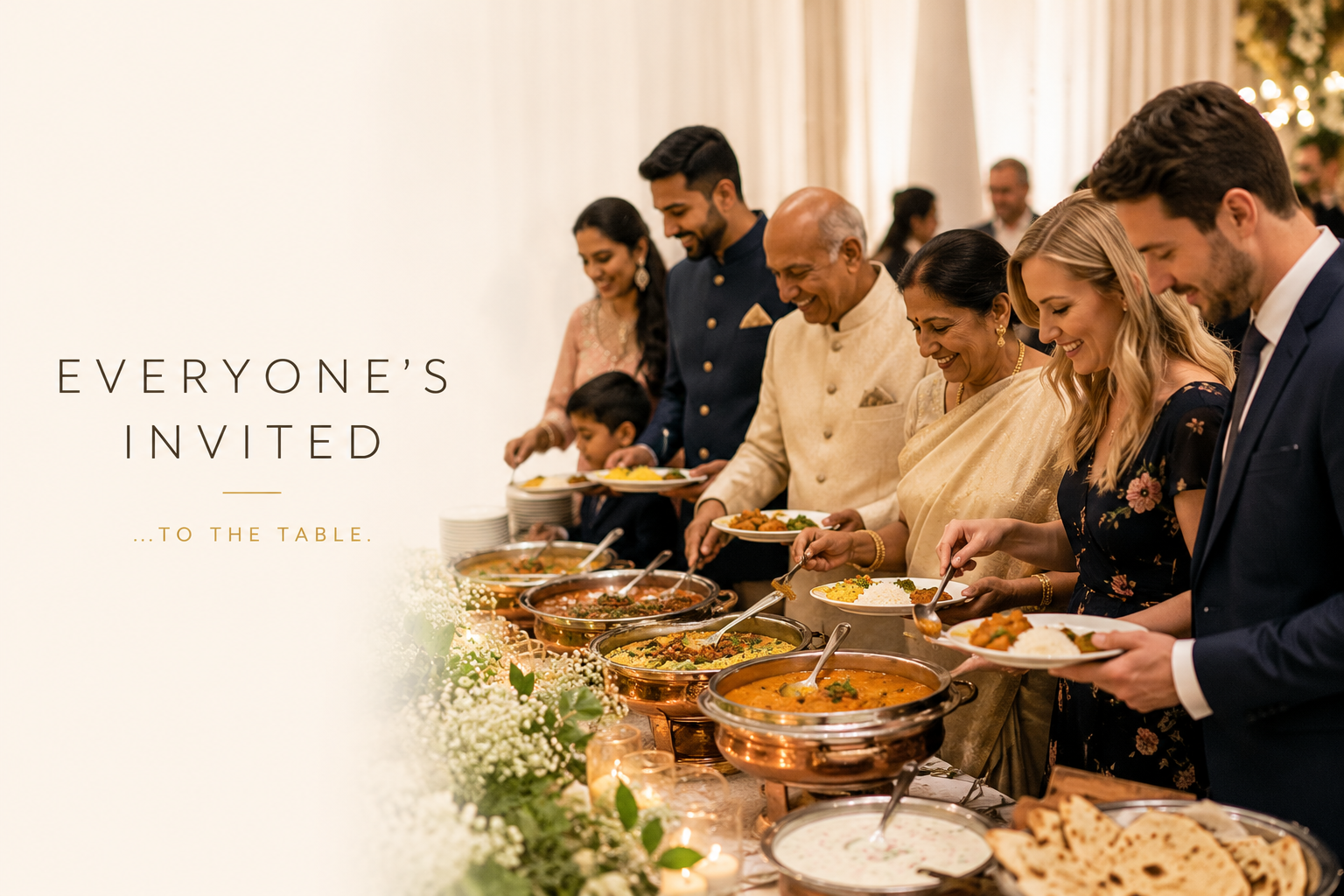
Indian Wedding Catering for Non-Indian Guests: How to Welcome Everyone to the Table Without Watering Anything Down
There is a conversation that happens in almost every planning meeting for a mixed-guest Indian wedding, and it usually goes something like this.
The couple — or more often, one of their mothers — raises a concern. Something along the lines of: “Some of our guests aren’t used to Indian food. Should we tone it down a little? Maybe add a few plain options?” And the caterer nods, makes a note, and the menu quietly gets adjusted. The lamb gets a little less spiced. The chaat counter gets scaled back. A pasta station appears somewhere near the back of the room.
The result, almost without exception, is a wedding where the Indian guests are eating apologetically seasoned food they would not choose at home, and the non-Indian guests are eating pasta at an Indian wedding. Nobody wins. And the food — which should be one of the great joys of the entire occasion — becomes something people politely navigate rather than genuinely enjoy.
This guide is about why that approach is wrong, what the right approach actually looks like, and how experienced Asian wedding caterers handle mixed guest lists in a way that is genuinely inclusive without compromising a single thing about the food itself.
The Assumption That Needs Challenging First
The instinct to dilute an Indian wedding menu for non-Indian guests is built on an assumption that does not hold up to scrutiny: that people who have not grown up eating Indian food will find it overwhelming, unfamiliar, or too intense to enjoy.
This might have been partially true in Britain twenty or thirty years ago. It is not true now.
Indian cuisine is, by a significant margin, the most popular cuisine in the UK. The nation’s relationship with Indian food spans generations. The Friday night curry, the Saturday afternoon biryani, the office lunch where someone always orders the dal makhani — these are not exotic experiences for the majority of British people, regardless of their background. British guests attending an Indian wedding in 2026 are, as a general rule, not encountering this food for the first time. They are encountering it at its best, prepared by people who have cooked it their entire lives, and they are almost always thrilled by that.
The guests who genuinely have limited experience of Indian food — perhaps some older relatives from abroad, or colleagues of the couple who have lived in areas with less exposure to South Asian cuisine — are not, in the main, frightened of flavour. They are curious about it. They want to be guided through it. And with the right approach from the catering team, they will leave the reception talking about the food for weeks.
The answer to a mixed guest list is never a blander menu. It is a more thoughtfully presented one.
What Non-Indian Guests Actually Find Challenging — and What They Don’t
Before designing a menu or briefing a catering team, it helps to understand what specifically causes hesitation for guests who are less familiar with Indian food. It is rarely the food itself. It is almost always one of three things.
Not knowing what something is. A guest standing in front of a buffet table with fifteen unlabelled dishes, some of which contain ingredients they cannot identify, will experience anxiety rather than excitement. They will take small portions of things that look familiar and miss the dishes they would have loved if someone had simply told them what they were. This is a presentation and labelling problem, not a food problem.
Not knowing how spicy something is. Heat tolerance varies enormously, and guests with lower spice tolerance are not poorly informed — they simply want to know what they are committing to before they fill their plate. An unlabelled dish that turns out to be significantly hotter than expected creates a memorable experience for the wrong reasons. A clearly indicated heat level removes all anxiety and allows guests to choose confidently.
Not knowing what to do with something. A guest who has never eaten a dosa before does not know whether to eat it with their hands, whether the accompanying chutneys are condiments or sauces, whether the small metal bowls beside the bread are for dipping or pouring. A brief, warm explanation from a member of the catering team transforms confusion into delight in about thirty seconds.
None of these challenges require changing the food. They require changing the experience of encountering the food — through labelling, through guidance, and through a service team that is briefed to help guests navigate the menu with warmth rather than waiting to be asked.
The Buffet Table as a Welcome, Not a Test
The way a buffet table is dressed and described does more for non-Indian guests than any adjustment to the menu itself.
Every dish should be clearly labelled with its name, a one-line description in plain English, and an indication of its heat level and whether it contains meat, dairy, gluten, or nuts. This is not just good hospitality — it is a legal requirement under UK allergen regulations, and professional caterers will have systems for this already. But the labelling should go beyond allergen compliance. It should function as a mini menu card that tells a guest not just what the dish is called, but what it tastes like.
Dal Makhani, for instance, might be labelled: Slow-cooked black lentils with butter and cream. Rich, warming, mildly spiced. Vegetarian. Seekh Kebab might read: Minced lamb with fresh herbs and warm spices, cooked in the tandoor. Mild-medium heat. Papdi Chaat might say: Crispy wafers with spiced chickpeas, yoghurt, tamarind and mint chutneys. The classic Indian street food snack. Vegetarian.
These are not lengthy descriptions. They take up very little space on a label card. But they transform the buffet from a row of dishes with unfamiliar names into an invitation — and an excited one at that.
Beyond labelling, the physical arrangement of the buffet should create a natural journey for guests. Starting with lighter, more approachable dishes — chaat, salads, raita, kebabs — and building towards the richer main courses gives guests a progression to follow. The overwhelming feeling that some people associate with a large Indian buffet comes almost entirely from not knowing where to start. A thoughtfully sequenced table removes that feeling entirely.
The Chaat Counter: The Single Best Introduction to Indian Food That Exists
If there is one element of an Indian wedding menu that converts non-Indian guests from cautious to evangelical, it is the live chaat counter.
Chaat — the family of street food preparations that includes Papdi Chaat, Pani Puri, Bhel Puri, Dahi Puri, and Sev Puri — is, by design, a food that invites