


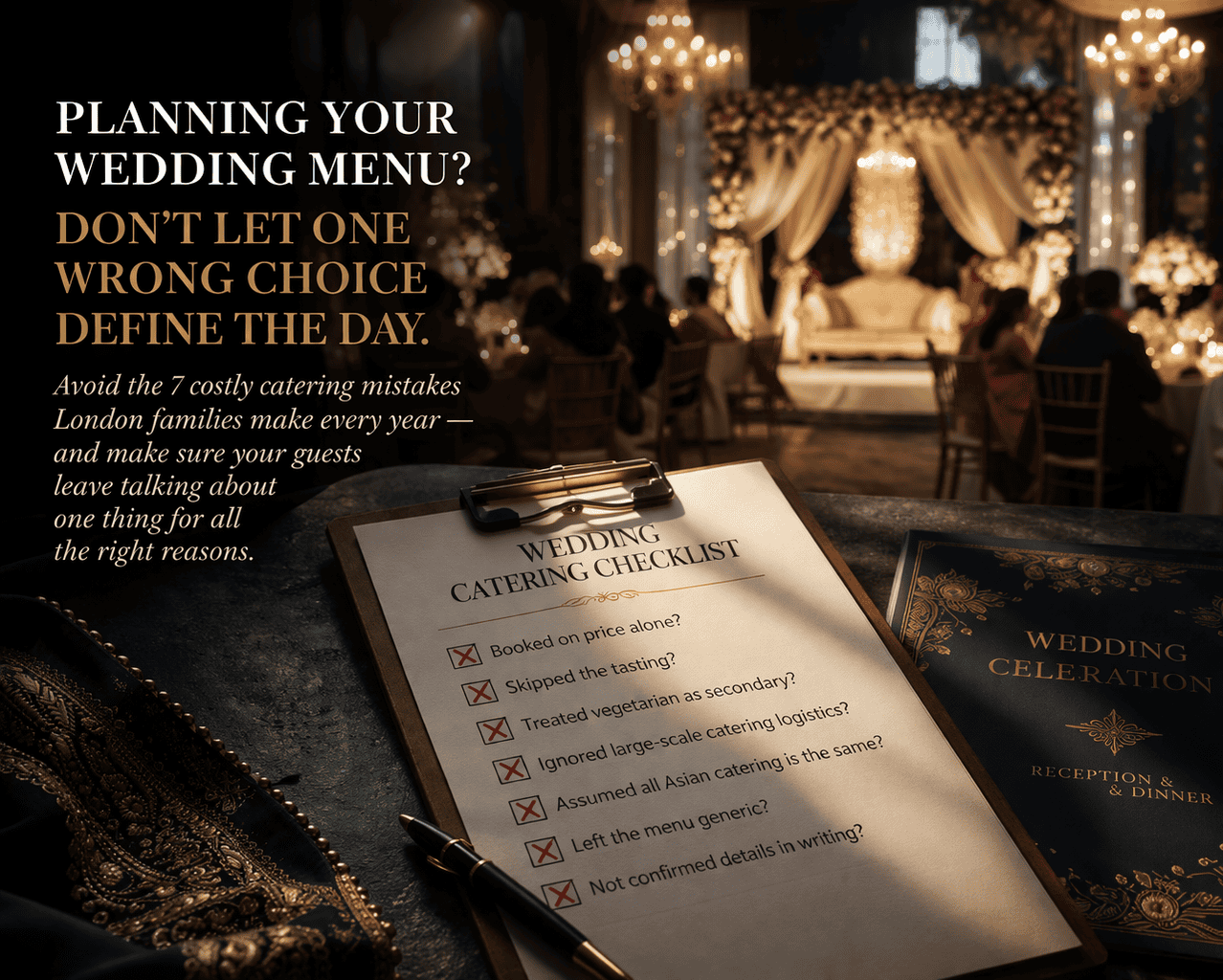
The 7 Mistakes People Make When Booking Asian Wedding Catering in London (And How to Avoid Every Single One)
There is an unspoken rule in corporate event planning that almost nobody questions: the food will be fine. Not remarkable. Not memorable. Just fine. A buffet that looks presentable at noon and slightly less so by two o’clock. Sandwiches that were made that morning. Something with pastry. A dessert table that nobody quite commits to.
It has become so accepted that most attendees arrive at corporate events having already eaten. Not because they are not hungry — but because they have learned, through experience, not to get their hopes up.
This is a significant missed opportunity. And for companies with South Asian leadership, a predominantly Asian workforce, or clients from communities where food carries genuine cultural weight, it is more than a missed opportunity. It is a statement — unintentional, but felt.
What Food Actually Does at a Corporate Event
The function of food at a corporate event is rarely discussed honestly. It is treated as fuel — something to keep people in the room and prevent blood sugar crashes during the afternoon sessions. But food does something far more important than that.
It signals how much thought went into the day. It tells your guests, your clients, and your team whether they were considered as people or managed as attendees. A room that smells of something genuinely good cooking creates a different atmosphere than one where trays of sandwiches have been sitting under cling film since delivery. People relax differently. Conversations start differently. The energy in the room shifts in ways that no keynote speaker or team-building exercise can manufacture.
The Clay Oven has catered corporate events for some of the UK’s most recognisable companies and institutions — from large-scale conferences to intimate boardroom lunches, from awards ceremonies to product launches. And in every case, the brief that matters most is not the menu itself. It is the impression the food leaves on everyone in the room.
The Live Station Difference
One of the most significant shifts in corporate event catering over the past decade has been the rise of live cooking stations — and for good reason. A live station does something a buffet simply cannot: it makes the food part of the event itself.
When a chef is grilling fresh Seekh Kebab or assembling a chaat station in front of your guests, people stop. They watch. They form small, natural clusters around the station and start conversations that would never have happened over a plate of cold pasta. The food becomes a social catalyst rather than a logistical afterthought.
For corporate events with a South Asian guest list — or any event where the host wants to make a genuine impression — live stations also communicate something important about standards. It says: we did not just order in. We brought a team. We thought about this.
The Clay Oven’s live stations menu has been developed specifically for events where the food needs to do more than sustain. It is built around dishes that travel well, hold their quality through extended service, and look as impressive at the end of service as they do at the beginning — because a corporate event is rarely a single sitting.
The Dietary Reality Nobody Plans For Properly
Here is a practical truth about corporate event catering that catches organisers off guard more often than it should: the dietary requirements of a South Asian guest list are significantly more complex than a standard event caterer is equipped to handle.
It is not just vegetarian versus non-vegetarian. It is Jain dietary requirements that go beyond vegetarianism. It is halal sourcing that needs to be verified, not assumed. It is guests who do not eat certain proteins for religious or cultural reasons that are not always captured on an RSVP form. It is the difference between a vegetarian dish that has been made with genuine care and one that has been assembled to tick a box.
Getting this wrong at a corporate event is not a minor inconvenience. It is the thing people remember. And it disproportionately affects guests who are already navigating the experience of being the only person at their table who cannot eat half of what is on offer.
The Clay Oven’s approach to dietary requirements is built on over four decades of catering for communities where these distinctions are not optional — where they are fundamental to how guests feel respected and included. That experience translates directly into corporate events, where the same care produces the same result: a room where everyone feels equally well looked after.
Scale Without Compromise
Corporate events present a catering challenge that most people underestimate until they are in the middle of it: the sheer logistics of feeding a large number of people, all at once, all to the same standard, in a venue that may or may not be well-equipped for large-scale food service.
The Clay Oven has catered events across some of the UK’s most complex venue configurations — from historic country houses with limited kitchen facilities to purpose-built conference centres and everything in between. The operational infrastructure required to deliver consistent, high-quality food for two hundred or five hundred guests in a venue you are visiting for the first time is considerable. It requires advance planning, the right equipment, a team that has done this before, and a head chef who maintains standards regardless of what the kitchen looks like when they arrive.
This is not something that can be improvised. It is earned through repetition, and The Clay Oven has the repetition behind them.
A Different Kind of Corporate Impression
The companies that understand food as a strategic element of their corporate events — rather than a logistical necessity — tend to be the ones whose events people actually want to attend. Where attendance is not driven by obligation but by genuine anticipation.
The food at a corporate event is one of the few elements that every single person in the room experiences directly. The speaker reaches the front rows more than the back. The networking activities favour the extroverts. But the food — good food, served well, with thought behind it — reaches everyone equally.
For companies planning events in London and across the UK who want their catering to reflect the same standards they apply to everything else, The Clay Oven is the conversation worth having.
Planning a corporate event? The Clay Oven provides specialist corporate catering across London and the UK. Call 020 8903 8800, email us, or visit www.theclayoven.co.uk to discuss your brief.
2 / 2
Here are a few options:
1. We’re putting the finishing touches on something great. Back very soon.
2. Good things take time. We’re almost ready — watch this space.
3. We’re behind the scenes making things better. Won’t be long.
4. A little patience goes a long way. We’re almost there.
5. Something better is coming. We’ll be back before you know it.
My pick is 1 — confident, warm and doesn’t overpromise.
All the blogs I’ve written for you are in this conversation — you can scroll up to find them. Here’s a quick list of everything written:
- From Seekh Kebab to Sandesh: How a Wedding Menu Tells the Story of Your Culture
- The Langar Spirit Lives Here: How The Clay Oven Approaches Sikh Wedding Catering
- Hindu, Muslim, Sikh, Tamil, Sri Lankan: Why One-Size-Fits-All Asian Catering Is a Myth
- The Clay Oven, Wembley: Where Every Table Has a Story
- The Guest List Is Sorted. The Venue Is Booked. Now — Have You Actually Thought About the Food?
- Why London’s Corporate Events Deserve Better Food Than They’re Getting
If you’d like, I can compile all six into a single Word document so you have them all in one place and can copy, edit and upload them to the website easily. Just say the word!
Here you go:
The moments that matter most deserve to be done properly. 🤍
Whatever the occasion, we’re here to make sure the food is the last thing you have to worry about.
📞 020 8903 8800 | theclayoven.co.uk
#TheClayOven #EventCatering #AsianCatering #WeddingCatering #CateringLondon #BespokeCatering #LuxuryCatering #AsianWedding #PrivateEvents
“The 7 Mistakes People Make When Booking Asian Wedding Catering in London (And How to Avoid Every Single One)”
The Clay Oven | Asian Wedding Catering Specialists, London
Nobody books wedding catering hoping it will go wrong. And yet, every year, families across London sit down at their wedding reception and feel the quiet, sinking disappointment of food that did not live up to what was promised. The starter arrived lukewarm. The biryani tasted like it had been made in bulk two days earlier. The vegetarian options were clearly an afterthought. The service ran out before the last tables were served.
These are not rare occurrences. They are the predictable result of very specific, very avoidable mistakes made months before the wedding day. Here are the seven most common — and what to do instead.
Mistake 1: Booking on Price Alone
This is the most common mistake and the one with the most painful consequences. Asian weddings are expensive. The pressure to cut costs somewhere is real. And catering, because it feels abstract at the booking stage, often ends up being where the compromise is made.
The problem is that food is the one element of your wedding that every single guest will experience directly and personally. They may not notice the centrepieces. They may not appreciate the lighting rig. But they will absolutely notice whether the food was genuinely good or quietly disappointing.
The right question is not “who is cheapest?” It is “who consistently delivers at the standard my guests will expect?” Those are very different conversations — and the answers lead you to very different caterers.
Mistake 2: Not Attending a Tasting
It is astonishing how many families book their wedding caterer without ever tasting the food first. They see a portfolio, read some reviews, and sign a contract based on descriptions and photographs. Photographs of food are not food.
A tasting is non-negotiable. It is the only way to know whether the Dal Makhani actually has the depth it needs, whether the Seekh Kebab is properly seasoned, and whether the team cooking your wedding food is as good as they say they are. Any reputable Asian wedding caterer will offer a tasting as standard. If they do not, that tells you something important.
At The Clay Oven, every wedding brief includes a tasting session — because we want families to book us knowing exactly what they are getting, not hoping it will match the description.
Mistake 3: Treating Vegetarian as Secondary
At a South Asian wedding, vegetarian food is not a dietary restriction to be accommodated. It is often the backbone of the entire menu — particularly at Hindu, Gujarati and Jain weddings where a significant portion of the guest list may not eat meat at all.
The mistake most caterers make is building the meat menu first and designing the vegetarian options around whatever space is left. The result is a vegetarian spread that feels derivative — Paneer dishes that lack imagination, dal that has clearly not been given the same attention as the lamb, sides that feel like fillers rather than centrepieces.
The right approach is to treat the vegetarian menu with exactly the same ambition as the rest. When that happens, the food is better for everyone — including the meat eaters.
Mistake 4: Ignoring the Logistics of Large Scale Catering
A wedding for three hundred guests is not the same as a dinner party for thirty. The logistics of feeding that many people — consistently, at temperature, all at the same standard — require a level of operational planning that separates experienced large scale Asian event caterers from everyone else.
Questions worth asking before you book: How many events of this size have you catered? What is your staffing ratio per guest? How do you manage service flow to ensure the last table receives the same quality as the first? How do you handle live stations at scale without creating bottlenecks?
If a caterer struggles to answer these questions clearly and confidently, that is important information.
Mistake 5: Assuming All Asian Catering Is the Same
This one surprises people, but it should not. Punjabi wedding food is not Gujarati wedding food. Tamil wedding catering is not Bengali wedding catering. Sri Lankan cuisine is entirely distinct from North Indian cuisine. Pakistani wedding food has its own specific dishes, preparation methods and cultural requirements.
Booking a caterer who is excellent at one regional cuisine to deliver a completely different one is a risk that families take far too often — usually because they do not ask the right questions, or because the caterer does not volunteer the information.
Ask specifically: have you catered a wedding like mine before? What regional dishes are you most experienced with? Can you show me examples? The answers will tell you everything.
Mistake 6: Leaving the Menu Too Generic
A wedding menu that could belong to anyone belongs to no one. The most memorable wedding food is specific — it carries the fingerprint of the family, the region, the tradition. It is the dish that only your grandmother makes, recreated at scale. It is the flavour profile that your family grew up with, present in every course.
The best Asian wedding caterers will push you to be specific. They will ask questions about your family’s food history, your regional background, the dishes that matter most. They will tell you when something is not achievable and suggest alternatives that still feel personal.
A generic menu is almost always a sign that the caterer is not asking enough questions — or that the family is not being asked to engage deeply enough in the process.
Mistake 7: Not Confirming the Details in Writing
This one sounds obvious. It is still the mistake that causes the most disputes. The tasting went well. The conversation was warm. There was a general agreement on the menu, the service structure, the dietary requirements. And then the wedding day arrives and something is missing, something is different, and the caterer’s recollection of the conversation does not match yours.
Every detail of your wedding catering should be confirmed in writing before any contract is signed — the exact dishes, the dietary accommodations, the staffing levels, the service structure, the timing, what happens if something is unavailable on the day. A reputable caterer will not only welcome this level of detail. They will insist on it.
The Common Thread
Every mistake on this list has the same root cause: not asking enough questions early enough. The wedding catering conversation is not one to defer until everything else is sorted. It is one of the first conversations worth having — because the right caterer, booked early, will make every other decision easier.
The Clay Oven has been having these conversations with London families for over forty years. We know the questions to ask, the details that matter, and the difference between a menu that sounds good in a meeting and food that is genuinely extraordinary on the day.
Thinking about your wedding catering? Start the conversation early. Visit www.theclayoven.co.uk, call 020 8903 8800, or find us at 197 Ealing Road, Wembley, HA0 4LW.