

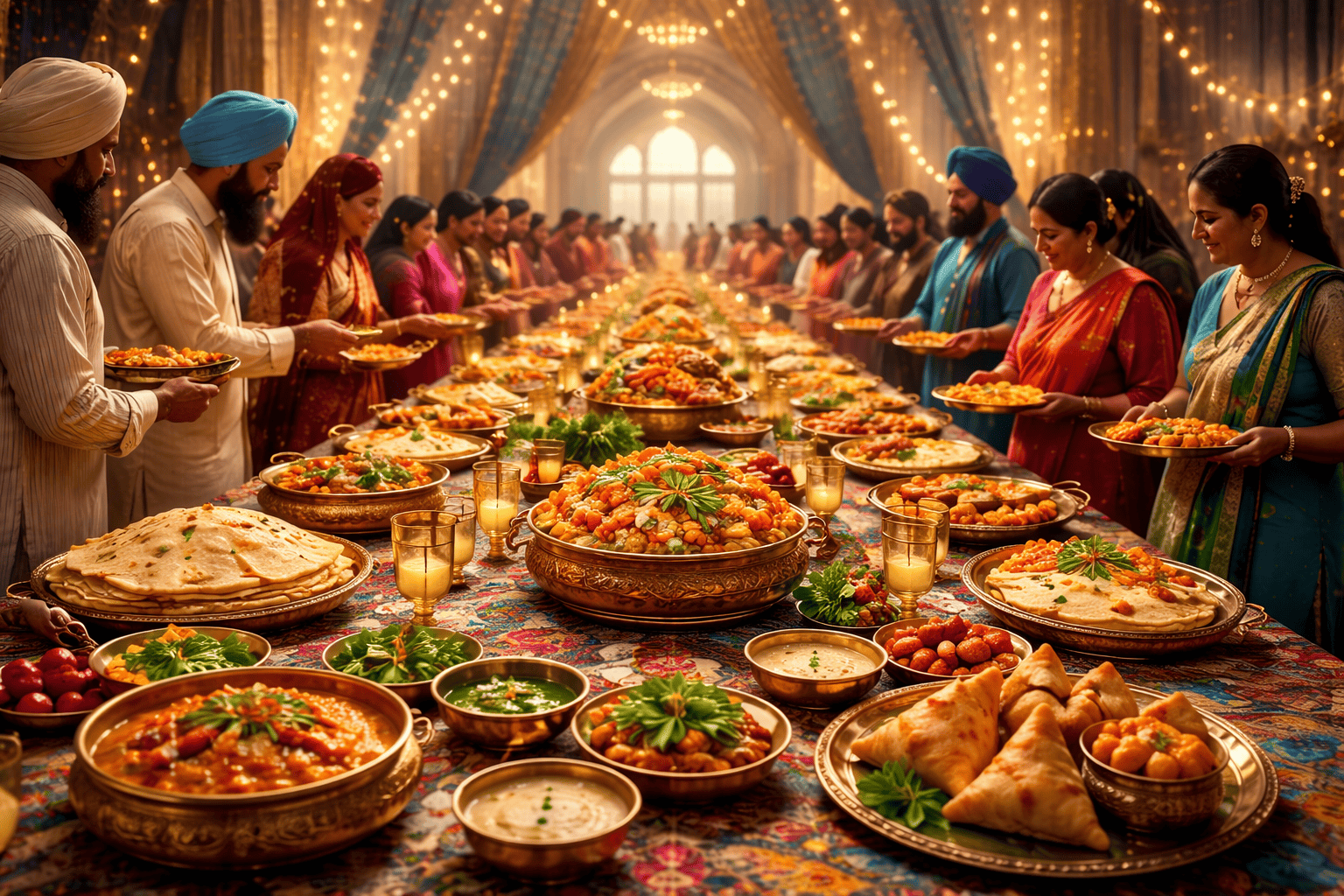
The Langar Spirit Lives Here: How The Clay Oven Approaches Sikh Wedding Catering
Walk into any Gurdwara in the world and you will find the same thing. It does not matter whether you are in Amritsar or Southall, whether it is a Tuesday morning or the middle of a festival. There will be food. There will be enough of it. And it will be offered to everyone — without question, without hierarchy, without anyone being made to feel like a guest of lesser importance.
That is the langar. And if you understand the langar, you understand everything about what a Sikh wedding reception should feel like.
At The Clay Oven in Wembley, Sikh wedding catering is not something we approach as just another brief to execute. It is a tradition we take seriously — because the families we work with take it seriously. And because, when it is done right, it produces something that no amount of floral arrangements or mood lighting can replicate: a room full of people who feel genuinely, wholeheartedly fed.
It Was Never Just About the Food
The langar tradition was established by Guru Nanak Dev Ji in the fifteenth century. Its purpose was radical for its time: to dismantle caste distinctions by sitting everyone at the same level and feeding them the same meal. Rich and poor, high-born and low-born, stranger and family — all equal at the table.
That spirit did not stay in the Gurdwara. It travelled into Punjabi homes, into community gatherings, and eventually into the wedding reception. When a Sikh family plans their wedding catering, they are — whether they articulate it this way or not — carrying that same instinct forward. The table must be generous. No one must feel overlooked. And the food must be good enough to honour the occasion.
This is why Sikh wedding food is never minimal. It is never curated to the point of scarcity. There is always more. That is not excess — it is intention.
What a Sikh Wedding Menu Actually Looks Like
There is a certain architecture to Punjabi wedding food that experienced Sikh wedding caterers understand instinctively. It begins long before the main meal — with starters that set the tone for everything that follows.
Seekh Kebab, still hot from the grill. Achari Chicken Tikka with that sharp, pickled edge that cuts through the richness. Paneer Tikka for the vegetarians — not as an afterthought, but as a dish that stands entirely on its own. Fish Amritsari, golden and crisp, that people inevitably come back for twice. These are not just appetisers. They are a statement of intent.
Then comes the main course, and this is where the philosophy of abundance becomes most visible. Lamb Rogan Josh that has been given the time it deserves — properly slow-cooked, the kind where the meat yields without any encouragement. Dal Makhani that has been on the heat since the early hours, developing that deep, almost smoky richness that you simply cannot rush. Chicken dishes with enough variation that even the most particular guest finds something they love. Aloo Dum for the vegetarians that is substantial enough to be a centrepiece in its own right, not an obligation.
And the bread. Always the bread. Freshly made Naan and Paratha, still warm, arriving in steady rotation throughout the meal because — and this is something every good Punjabi wedding caterer knows — the moment the bread runs out, the atmosphere changes. That never happens on our watch.
Raita. Chutneys. Rice. The supporting cast that holds the whole meal together and that, when done properly, elevates everything around it.
The Vegetarian Question — and Why It Is Not a Question at All
One thing that sets Sikh wedding catering apart is the genuine centrality of vegetarian food. In many catering contexts, vegetarian options are accommodations — dishes added to serve a portion of the guest list. In Sikh wedding catering, this dynamic is completely different.
Many Sikh families choose a fully vegetarian menu, in keeping with the langar tradition. Others have a mixed menu but expect the vegetarian dishes to carry equal weight — equal thought, equal technique, equal pride of place on the table. A vegetarian Dal Makhani is not a concession. It is, for many guests, the dish they have been waiting for all evening.
At The Clay Oven, we understand this distinction completely. Our vegetarian dishes are not reduced versions of something else. They are their own thing, developed with the same care and attention as everything else on the menu. When a guest who has eaten Dal Makhani their whole life tastes ours and nods — that is the validation we work for.
Feeding 300 People as if You Are Feeding Family
Here is the practical reality that no one talks about enough when it comes to large scale Asian event catering: scale is where corners get cut, and scale is where guests notice.
A Sikh wedding reception is rarely a small affair. Two hundred guests is considered modest. Three hundred to five hundred is not unusual. And feeding that many people — all at once, all to the same standard, all with the warmth and generosity that the occasion demands — requires a level of operational precision that goes far beyond simply cooking good food.
It requires the right team, the right equipment, the right service structure, and the right experience. It requires knowing that the lamb needs to go in at a certain time, that the Naan station needs to be staffed consistently throughout service rather than in waves, that the dessert timing matters more than most caterers admit.
It also requires someone to have the honest conversation with you during planning: how many guests are genuinely expected, what is the realistic flow of service, where the bottlenecks will occur, and how to build a menu that can be executed at scale without the last hundred guests receiving something noticeably different from the first hundred.
These are the conversations we have with every Sikh wedding family we work with. Because getting it right on the day is not luck. It is preparation.
The Moment That Makes It All Worth It
There is always a moment — usually somewhere in the middle of the main course — when the noise in the room changes. The conversation gets louder. The laughter gets easier. People who arrived as strangers to each other are leaning across the table, pointing at dishes, telling each other what to try next.
That is the langar spirit, alive in a wedding reception in Wembley. That is what happens when the food is right — when it is abundant without being wasteful, generous without being careless, rooted in tradition without being stuck in it.
Guru Nanak’s principle was simple: sit together, eat together, and something shifts. Titles fall away. Differences soften. What remains is just people, sharing a meal, on one of the most important days of a family’s life.
That is what we try to honour at The Clay Oven. Every plate, every table, every wedding.
Planning a Sikh wedding reception? We would love to talk through your menu. Visit us at www.theclayoven.co.uk or find us at 197 Ealing Road, Wembley, HA0 4LW.