


The Mehndi Night Menu: Why Pre-Wedding Catering Deserves as Much Attention as the Main Event
Ask any South Asian family which part of the wedding weekend they remember most vividly, and the answer is rarely straightforward. Yes, the wedding day itself carries the weight of ceremony and emotion. But the mehndi night — that loose, celebratory, music-filled evening the day before — has a way of staying with people in a different kind of way. It is the night when everyone is still relaxed. When the dancing starts before dinner is finished. When the bride’s aunts are louder than the DJ and nobody minds at all.
It is also, almost universally, the night where the catering gets the least amount of planning.
That is a mistake. And it is one that The Clay Oven has been quietly helping families avoid for over forty years.
What the Mehndi Night Actually Is — And Why the Food Matters
For those outside South Asian wedding culture, the mehndi ceremony is a pre-wedding celebration — typically held the evening before the wedding day — where the bride’s hands and feet are adorned with intricate henna designs. It is a deeply social occasion, rooted in tradition, and in modern South Asian weddings it has grown into a full evening event in its own right.
In Punjabi households, the mehndi night is loud, colourful and unapologetically joyful. In Gujarati families, it often carries more ritual alongside the celebration. In Bengali and South Indian traditions, the equivalent ceremonies have their own distinct character. But across every community, the constant is this: people gather, they stay for hours, and they need to be fed — properly fed, not as an afterthought.
The mehndi night is not a lesser occasion. It is the warm-up act that sets the emotional tone for everything that follows. And just like any warm-up act worth its billing, the food needs to perform.
Why Mehndi Night Catering Is a Different Brief
Here is where the planning conversation often goes wrong. Families who have spent months curating the perfect wedding day menu — the starters, the live stations, the dessert spread — arrive at the mehndi night catering conversation with a fraction of that energy. The instinct is to simplify. Maybe a buffet. Maybe some snacks. Something easy.
The problem with easy is that it shows. Guests who arrive at a mehndi night to find a perfunctory spread of dishes that clearly did not receive the same thought as the wedding menu will notice. They may not say anything. But they notice.
Mehndi night catering has its own requirements — and they are distinct from the main wedding day in ways that matter. The service is usually less formal, which means the food needs to work in a more relaxed setting. People eat at different times throughout the evening rather than in a single coordinated sitting. The atmosphere is celebratory but casual, which means the food should reflect that — flavourful, accessible, easy to eat while standing or dancing, and varied enough to keep people coming back.
It is a different brief. And it deserves a caterer who understands that difference.
What a Great Mehndi Night Menu Actually Looks Like
The best mehndi night menus share a few qualities. They are generous without being overwhelming. They are built around dishes that work at room temperature as well as hot — because in a relaxed evening format, not everything arrives at the same moment. They include options that travel across the room in guests’ hands without requiring a knife and fork. And they are varied enough that the food itself becomes part of the conversation.
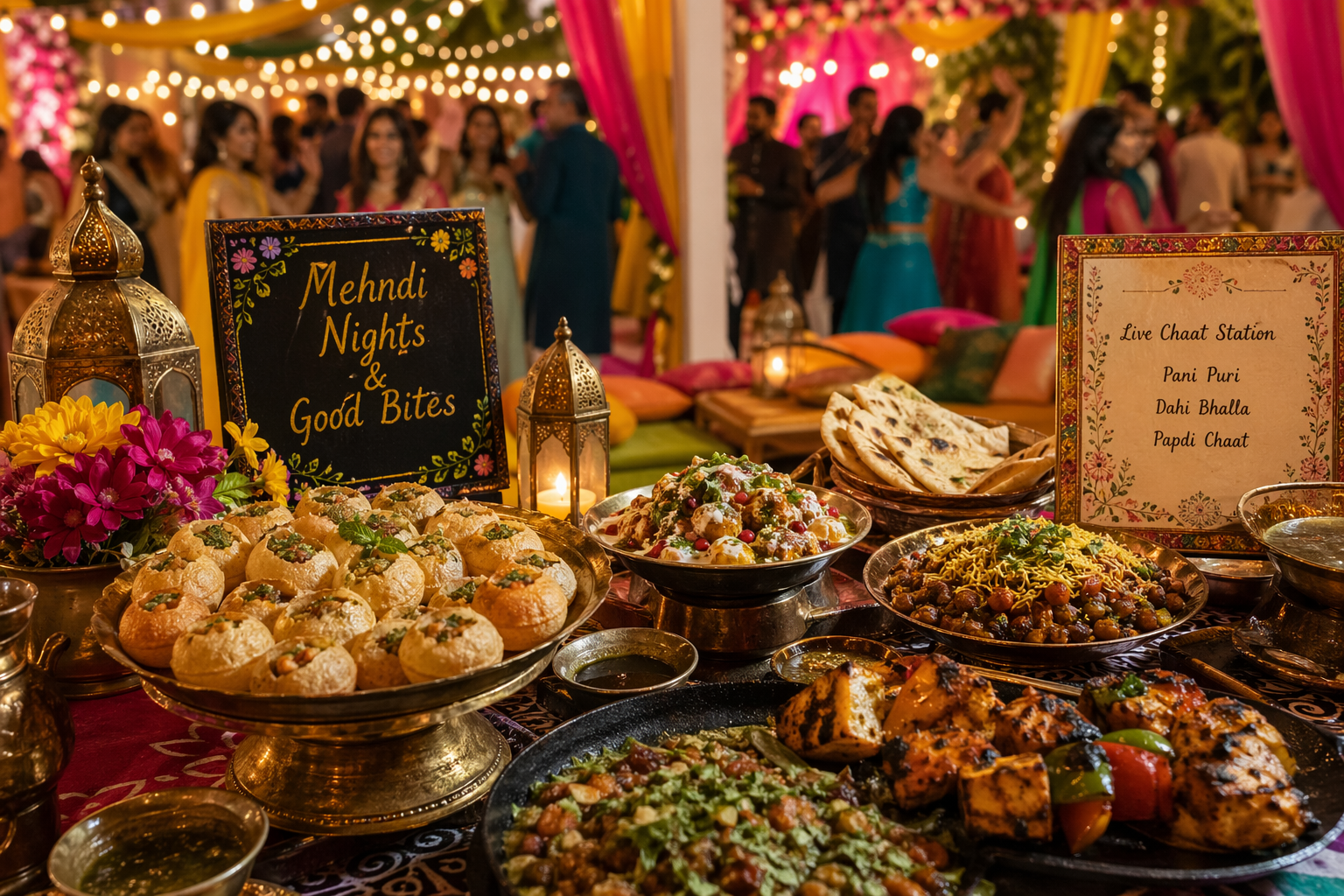
At The Clay Oven, mehndi night catering leans heavily into the street food and live station format — for very good reason. A live chaat station is perfect for a mehndi evening. Guests drift toward it throughout the night, it is endlessly customisable, and the theatre of it adds to the atmosphere rather than interrupting it. Similarly, a live Pani Puri counter, a fresh Dahi Bhalla setup, or a Papdi Chaat station creates an interactive food experience that suits the loose, social energy of a mehndi night perfectly.
For the more substantial elements, dishes like Seekh Kebab, Chicken Tikka, Paneer Tikka and Achari Chicken arrive well on a platter format and work across a range of dietary requirements without the menu feeling compromised. Dal Makhani, Aloo Dum and fresh Naan served from a live station ensure that guests who want something more substantial are equally well looked after.
The dessert course at a mehndi night should feel indulgent and celebratory — Gulab Jamun, Kulfi, Gajjer Ka Halwa — dishes that feel festive without being heavy, and that bring the evening to a satisfying close.
The Dietary Reality of a Pre-Wedding Gathering
One thing that experienced pre-wedding event caterers know — and that families often discover too late — is that the dietary landscape of a mehndi night can be even more complex than the wedding day itself.
The mehndi guest list frequently includes a wider mix of generations and family branches than the core wedding day. Extended family members with specific dietary requirements, children who need something simple and reliable, elderly guests who cannot manage spicy food — all of these guests are present at the mehndi night, often in greater numbers than anywhere else in the weekend.
Getting this right requires thinking about the menu as a whole ecosystem rather than a list of dishes. At The Clay Oven, every pre-wedding catering brief includes a detailed dietary conversation — not a box-ticking exercise, but a genuine discussion about who will be in the room and what will make every single one of them feel looked after.
For Muslim families, halal sourcing and kitchen management are non-negotiable requirements that extend to the mehndi night as much as the wedding day itself. For Jain guests, the requirements go beyond vegetarianism in ways that a non-specialist caterer will not always anticipate. For families with mixed cultural backgrounds, the menu needs to speak to multiple traditions without feeling like a compromise to any of them.
These conversations are the ones that separate experienced Asian wedding caterers from those who are attempting to operate in a space they do not fully understand.
The Venue Question
Mehndi nights take place in a wider variety of settings than the wedding day itself — family homes, hired halls, outdoor spaces, banqueting suites. Each setting presents its own catering requirements. A mehndi night at a family home in North London is a fundamentally different logistical brief from one at a large banqueting hall in Wembley, even if the menu is identical.
The Clay Oven caters mehndi nights and pre-wedding events across London and its surrounding areas — at our own suites at Wembley, at external venues, at country house settings like Denham Grove and Hunton Park, and at private addresses where the setup requires a team that can bring everything with them and leave no trace behind.
That flexibility — the ability to deliver the same standard of food and service regardless of where the event is taking place — is something that only comes from genuine large scale Asian event catering experience. Knowing how to adapt to a venue you have never seen before, brief the kitchen around facilities that may be limited, and still serve food that meets the standard your guests expect — that is not something that can be improvised.
The Weekend as a Whole
What The Clay Oven always encourages families to think about — and what the best wedding planning conversations eventually arrive at — is the wedding weekend as a single, continuous experience rather than a series of separate events.
The mehndi night menu should complement the wedding day menu rather than duplicate it. If the wedding day features a formal Punjabi spread with all the ceremony that entails, the mehndi night is the opportunity to be a little more playful — to bring in the street food elements, the interactive stations, the dishes that feel celebratory in a different way. If the wedding day menu is already varied and expansive, the mehndi night can afford to be more focused and intimate.
That kind of joined-up thinking requires a caterer who is involved in both conversations. It is one of the reasons that families who work with The Clay Oven for their wedding day so often come back to us for the mehndi night — and the walima, and the anniversary dinner, and everything else that follows.
Because when the food is this good, people remember. And they come back.