


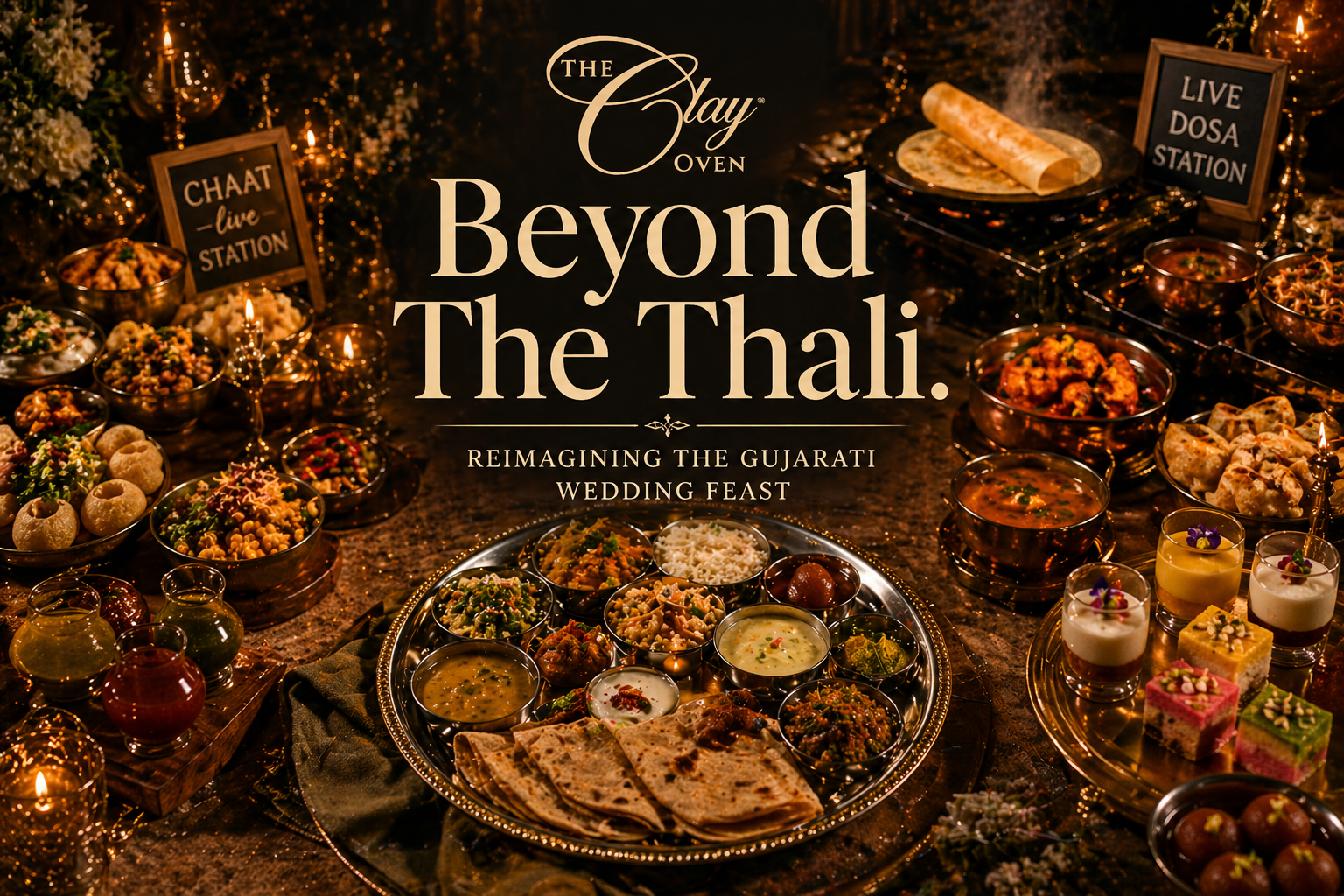
Why Gujarati Weddings Need More Than Just a Thali: Reimagining the Vegetarian Feast
There’s a quiet assumption that’s been sitting in the corner of British Gujarati weddings for far too long: that a thali is enough.
Pull up a chair, lay out the steel compartments, fill them with the same six dishes your grandmother served, your mother served, and now you’re serving — and the catering is done. Tradition honoured. Boxes ticked. Move on.
But here’s the truth most caterers won’t tell you, and the truth that the next generation of Gujarati couples in London are starting to notice: a thali, on its own, is no longer doing justice to a Gujarati wedding. Not the scale of it. Not the sophistication of it. And certainly not the diversity of palates sitting at every table.
It’s time to reimagine the vegetarian feast.
The Thali Is Sacred — But It Was Never Meant to Stand Alone
Let’s get one thing straight before we go any further: this isn’t an argument against the thali. The Gujarati thali is one of the most extraordinary expressions of vegetarian cooking anywhere in the world. The balance of sweet, salty, sour, spicy and bitter on a single platter. The interplay of farsan, shaak, dal, kadhi, rotli, rice and mithai. The way it tells the story of a region’s seasons, climate and philosophy on one steel tray.
It is, genuinely, a masterpiece.
But the thali was designed for a domestic table — a family meal, a community gathering, an everyday celebration of plenty. It was never engineered to carry the weight of a 500-guest wedding reception, where guests arrive at different times, where children want something to nibble on, where elderly relatives need softer textures, and where younger cousins are quietly wondering if there’s anything beyond the dishes they grew up eating.
A wedding is not a thali occasion. A wedding is an event. And events need menus that breathe.
What Modern Gujarati Couples Are Actually Asking For
Over the last few years at The Clay Oven, we’ve noticed a clear shift in the conversations we’re having with Gujarati families planning their weddings. The questions have changed.
It used to be: “Can you do a proper Gujarati thali?”
Now it’s: “Can you do a proper Gujarati thali — and also a chaat counter, and a live dosa station, and a few Indo-Chinese options for the cousins, and something interesting for the non-Gujarati side of the family, and a dessert table that isn’t just shrikhand?”
That’s not a betrayal of tradition. That’s the natural evolution of a community whose weddings are now hosting friends from every background, whose guest lists span four generations, and whose couples have grown up eating Gujarati food at home and the rest of the world’s food everywhere else.
The job of a modern Gujarati wedding caterer isn’t to abandon the thali. It’s to build an entire vegetarian feast around it.
Reimagining the Vegetarian Feast: Five Layers That Change Everything
When we plan a Gujarati wedding menu at The Clay Oven, we don’t think in terms of a single course. We think in layers — each one adding a different texture, a different temperature, a different tempo to the day.
1. The Welcome Layer: Where the Feast Begins
The moment guests walk in, the catering should already be working. This is where chaat counters, kachori bars and live pani puri stations earn their keep. Hot, fresh, theatrical, interactive — and unmistakably ours. A well-run sev puri station with three different chutneys does more for the atmosphere of a Gujarati wedding than another tray of identical samosas ever could.
2. The Live Station Layer: Theatre Meets Tradition
Live cooking stations have transformed what a vegetarian wedding feast can look like. A dosa counter rolling out fresh masala dosas. A pav bhaji station with the bhaji bubbling on a tava the size of a coffee table. A handi paneer counter where guests can watch the dish come together. These aren’t gimmicks. They’re a way of bringing the energy of a Gujarati street market into a banqueting hall, and they keep the food hot, fresh and engaging from the first guest to the last.
3. The Thali Layer: The Heart of It All
This is where tradition takes its rightful place. A properly executed Gujarati thali, served at the table with attentive staff offering second and third helpings, is still the emotional centre of the meal. The undhiyu in winter. The dudhi muthia. The osaman. The rotli served warm, one at a time. The kadhi that tastes like someone’s mother made it because, frankly, someone’s mother probably advised on the recipe. This is non-negotiable. This is the soul of the feast. But it’s the soul, not the entire body.
4. The Crossover Layer: Food for Every Guest in the Room
British Gujarati weddings rarely feature only Gujarati guests. There are Punjabi in-laws. South Indian friends. Sri Lankan colleagues. English neighbours. Cousins who’ve grown up on Indo-Chinese takeaways. A vegetarian feast that works for a modern wedding has to acknowledge this reality without losing its identity. We do this by introducing carefully chosen vegetarian dishes from beyond Gujarat — paneer tikka from the tandoor, vegetable hakka noodles, gobi Manchurian, masala dosa, paneer makhani — all sitting alongside the Gujarati core, never replacing it.
5. The Dessert Layer: The Final Word
Shrikhand and jalebi will always have their place. But a modern Gujarati dessert spread can do so much more — kulfi falooda counters, mango mousse verrines, gulab jamun cheesecake, paan-flavoured panna cotta, live jalebi made fresh in front of guests. Dessert is the last thing your guests will taste, and it should leave them genuinely surprised.
Why “Pure Veg” Is a Strength, Not a Limitation
There’s a tendency in some catering circles to treat a vegetarian wedding as a constraint. No meat to fall back on. No tandoori chicken to anchor the menu. What do we even do?
This thinking is exactly why so many Gujarati wedding menus end up feeling smaller than the occasion deserves.
A pure vegetarian feast is not a limitation. It’s a creative invitation. Vegetarian Indian cooking is one of the most varied, technically demanding and flavour-rich cuisines on the planet. The depth of paneer preparations alone — kadai, makhani, lababdar, tikka, bhurji, shahi — could anchor an entire menu without repetition. Add the lentil work, the regional breads, the dry vegetable preparations, the wet curries, the rice dishes, the chaats, the live items, the desserts, and suddenly the question isn’t “what can we serve?” but “how do we possibly fit it all in?”
The best Gujarati weddings we cater for are the ones where the bride’s family says, at the end of the night, that no one missed the meat. Not because they didn’t notice — but because the food was so good, the question never came up.
What to Look for in Your Gujarati Wedding Caterer
If you’re planning a Gujarati wedding in London or anywhere across the UK, and you’ve read this far, here’s the practical bit. Five questions worth asking any caterer before you sign:
Do they understand regional Gujarati cooking, not just generic Indian vegetarian? Surti undhiyu is not the same as Kathiyawadi undhiyu. A caterer who can’t tell you the difference probably can’t cook either of them properly.
Can they confidently build a menu beyond the thali? If their answer to “can we do live stations and a chaat counter alongside the thali” is hesitant, look elsewhere.
How do they handle Jain guests, allergies and the elderly? A real wedding caterer plans for the edges of the room, not just the middle.
Do they have experience at scale? A 200-guest dinner is a different animal from a 600-guest reception. Ask for references at your size.
Have they catered at your venue before? This matters more than people realise. Familiarity with a venue’s kitchen, layout and logistics translates directly into smoother service on the day.
The Last Word
A Gujarati wedding is one of the most joyful, abundant, generous events in British Asian life. The food at it should reflect that — not shrink to fit a template that was set decades ago and hasn’t been questioned since.
The thali stays. The thali always stays. But around it, there’s room for so much more — and the families who plan their weddings with that mindset are the ones whose guests are still talking about the food months later.
That, in the end, is what catering a wedding is really about. Not just feeding people. Making sure they remember.
If you’re starting to plan a Gujarati wedding and you’d like to talk about what a properly reimagined vegetarian feast could look like for your day, our team would love to hear from you. With over 40 years of experience catering Asian weddings across London and the UK, and our own venues at Wembley, Denham Grove and Hunton Park, we know what it takes to turn a guest list into a memory.
Get in touch with The Clay Oven — and let’s start the conversation.