


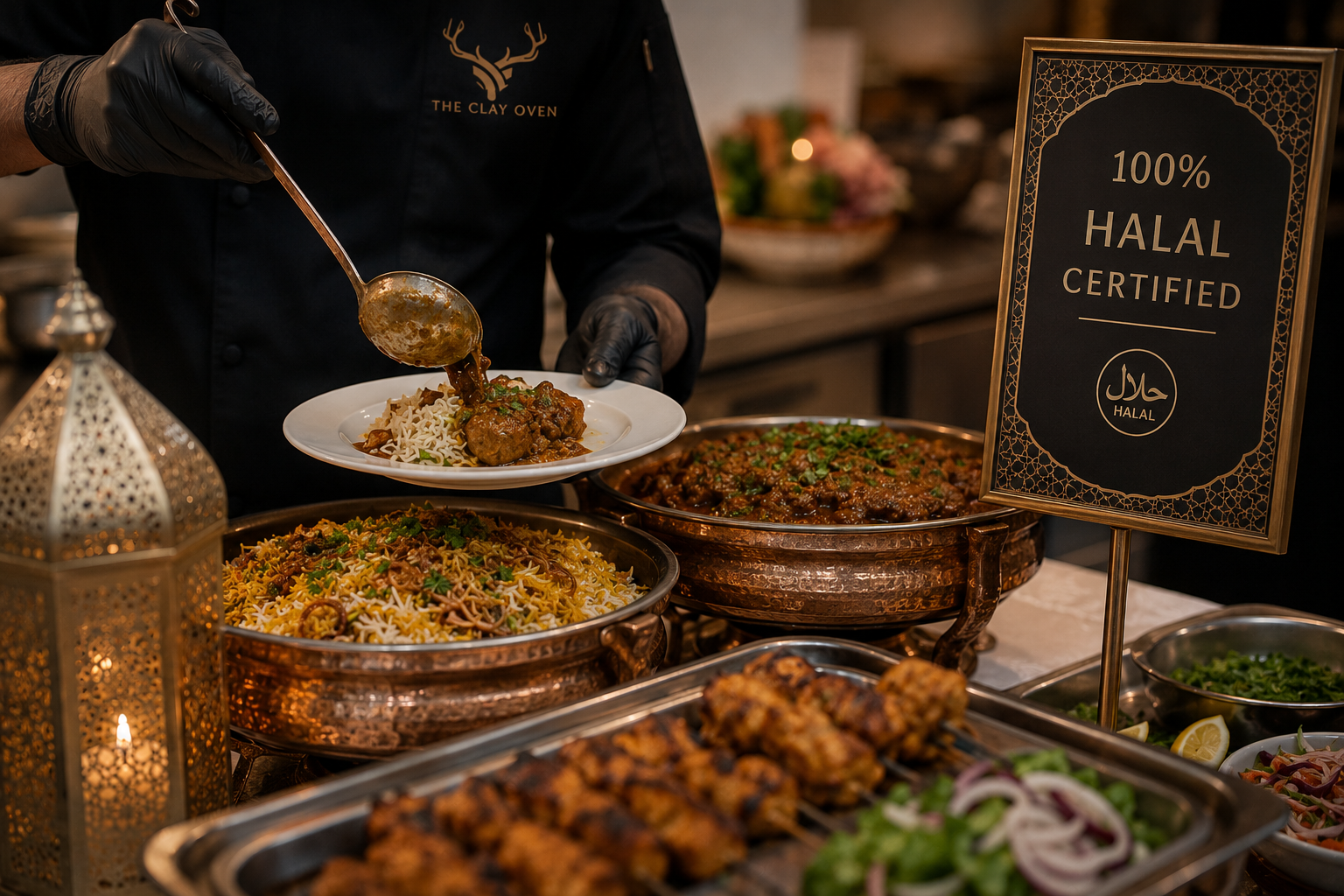
8 Halal Wedding Catering Questions Muslim Families Should Ask Before Booking
Before booking a halal wedding caterer, Muslim families should confirm the kitchen is fully halal (not shared with non-halal food), ask to see HMC or HFA certification, check where the meat is sourced, and understand how the caterer handles multiple events like the Nikah and Walima. Those questions protect the one thing you can’t compromise on — and the full checklist below covers everything else that matters before you sign.
For a Muslim wedding, halal isn’t a preference or a menu tick-box. It’s a religious requirement that runs through every dish, and it deserves more than a caterer’s casual “yes, of course it’s halal.” The families who feel completely at ease on their wedding day are the ones who asked the specific questions early — the ones that separate a genuinely halal operation from one that simply says the word.
At The Clay Oven, we’ve catered Muslim weddings for decades, from intimate Nikah ceremonies to large Walima receptions, and we know how much peace of mind comes from getting these details confirmed in writing. Here are the eight questions every Muslim family should ask before booking.
1. Is your kitchen fully halal, or shared with non-halal food?
This is the question that matters most, and it’s the one caterers are sometimes vague about. There’s a real difference between a caterer who runs a dedicated halal kitchen and one who prepares halal and non-halal food in the same space using the same equipment.
Ask directly: is the entire kitchen halal, or are halal dishes prepared alongside non-halal ones? If facilities are shared, ask exactly how they prevent cross-contamination — separate preparation areas, separate utensils, separate cooking equipment, and separate storage. A caterer who takes halal seriously will answer this clearly and in detail, without treating it as an awkward question.
2. Can you show me your HMC or HFA certification?
A verbal assurance isn’t the same as certification. In the UK, the two most recognised halal certifying bodies are the Halal Monitoring Committee (HMC) and the Halal Food Authority (HFA), and a properly certified caterer will be happy to show you their documentation.
Ask which body certifies them and ask to see it. Certification matters because standards differ — HMC, for example, is generally regarded as stricter on stunning and monitoring. Knowing which standard a caterer meets lets your family decide whether it aligns with what you’re comfortable with, rather than assuming.
3. Where do you source your meat, and can you verify the supply chain?
Certification covers the caterer, but it’s worth understanding the supply chain behind it. Ask where the meat comes from, whether their suppliers are themselves certified, and whether they can trace the chain from supplier to plate.
This matters most for larger weddings, where a caterer may be sourcing significant volumes from multiple suppliers. A confident, specific answer here — named suppliers, clear certification, a traceable chain — is a strong sign you’re dealing with a caterer who treats halal integrity as central, not as marketing.
4. How do you handle alcohol at the event?
Many Muslim families want a completely alcohol-free celebration, while others hold events at venues where alcohol is served to some guests. Either way, it’s worth being clear about the caterer’s role and boundaries upfront.
Ask whether they can guarantee no alcohol touches the food or the preparation (some dishes and desserts use alcohol-based ingredients you might not expect), how they handle service if the venue has a bar, and whether they’re comfortable working within your family’s requirements. A caterer experienced with Muslim weddings will already understand these sensitivities.
5. Have you catered Nikah and Walima events before, and how do you approach each?
A Muslim wedding often spans more than one event, and each has its own character. The Nikah may call for something more intimate, while the Walima reception is the larger celebration where the food takes centre stage. A caterer who understands this won’t simply serve the same menu twice.
Ask how they approach the different events, whether they offer a combined package across your Nikah, Mehndi and Walima, and how they keep the menus distinct so guests attending everything enjoy variety rather than repetition. Experience with the specific rhythm of Muslim weddings is worth looking for.
6. What’s your price per head — and does it include everything?
Halal integrity comes first, but budget clarity matters too. As with any wedding caterer, “per head” can mean very different things, so make sure you know exactly what the number covers.
For context, halal Asian wedding catering in London in 2026 generally ranges from around £25–£35 per head for a buffet, £40–£55 for a mid-range spread, and £60–£80+ for premium service with live stations. Ask whether the quote includes VAT, service staff, setup, clear-down, and crockery — or whether those are added later. A £60 quote excluding VAT is really £72 a head, which on 300 guests is a £3,600 difference you’ll want to know about before signing, not after.
7. Can we arrange a tasting, and how many family members can attend?
For most Muslim families, the wedding menu is a family decision, not just the couple’s. A tasting is your opportunity to confirm the food matches the promise and to bring the relatives whose opinion carries weight.
Ask whether tastings are included or charged, how many people can attend, and whether you can taste the specific dishes you’re considering. Beyond the food itself, the tasting tells you a lot about how the team listens, takes feedback and handles a family with strong views — all of which you’ll rely on come the wedding day.
8. Who runs the catering on the day, and what’s your backup plan?
Finally, know who’s actually in charge on the day. The person who guided you through planning isn’t always the person on-site during your Walima. Ask for the name and role of the person who’ll be running your catering live, and ask what contingency they carry if equipment fails, a delivery runs late, or guest numbers swell.
A caterer with real high-volume experience will have clear answers — backup equipment, spare staff, a single point of contact — because they’ve handled the unexpected many times before. That reassurance is exactly what you want when hundreds of guests are relying on the kitchen.
Your quick pre-booking checklist
Before you commit, make sure you have clear, written answers on: whether the kitchen is fully halal or shared; HMC or HFA certification; meat sourcing and supply chain; the caterer’s approach to alcohol; experience with Nikah and Walima events; price per head and exactly what it includes; VAT and service charges; tasting arrangements; and who runs the day with what backup plan. A caterer who answers all of these confidently is one you can trust with the most important part of your celebration.
Frequently asked questions
What’s the difference between HMC and HFA halal certification? Both are UK halal certifying bodies. HMC (Halal Monitoring Committee) is generally regarded as the stricter standard, with tighter rules on stunning and continuous monitoring, while HFA (Halal Food Authority) is also widely recognised. Ask your caterer which body certifies them so your family can decide whether it matches your requirements.
How can I be sure a wedding caterer is genuinely halal? Ask whether they operate a fully halal kitchen or share facilities with non-halal food, request to see their HMC or HFA certification, and ask where their meat is sourced. A genuinely halal caterer will provide all of this clearly and without hesitation.
Can one caterer handle the Nikah, Mehndi and Walima? Yes. An experienced Muslim wedding caterer can plan all your events together, often at a better combined rate, and will keep the menus distinct so guests attending everything enjoy variety across the days rather than the same dishes repeated.
How much does halal wedding catering cost per head in the UK in 2026? Halal Asian wedding catering in London typically ranges from around £25–£35 per head for a buffet, £40–£55 for a mid-range menu, and £60–£80 or more per head for premium service with live stations. Always confirm whether VAT, staff and crockery are included before comparing quotes.
Do halal caterers serve alcohol-free weddings? Many experienced Muslim wedding caterers cater entirely alcohol-free events and will ensure no alcohol is used in the food or its preparation. If your venue serves alcohol to some guests, discuss how the caterer manages this within your family’s requirements before booking.
Planning a Nikah or Walima in London and want a caterer who answers every one of these questions before you ask? The Clay Oven has catered Muslim weddings for decades, with a trusted halal kitchen, our own banqueting suites and venues, and a menu range from classic biryani to modern live stations. Get in touch to arrange a tasting.