


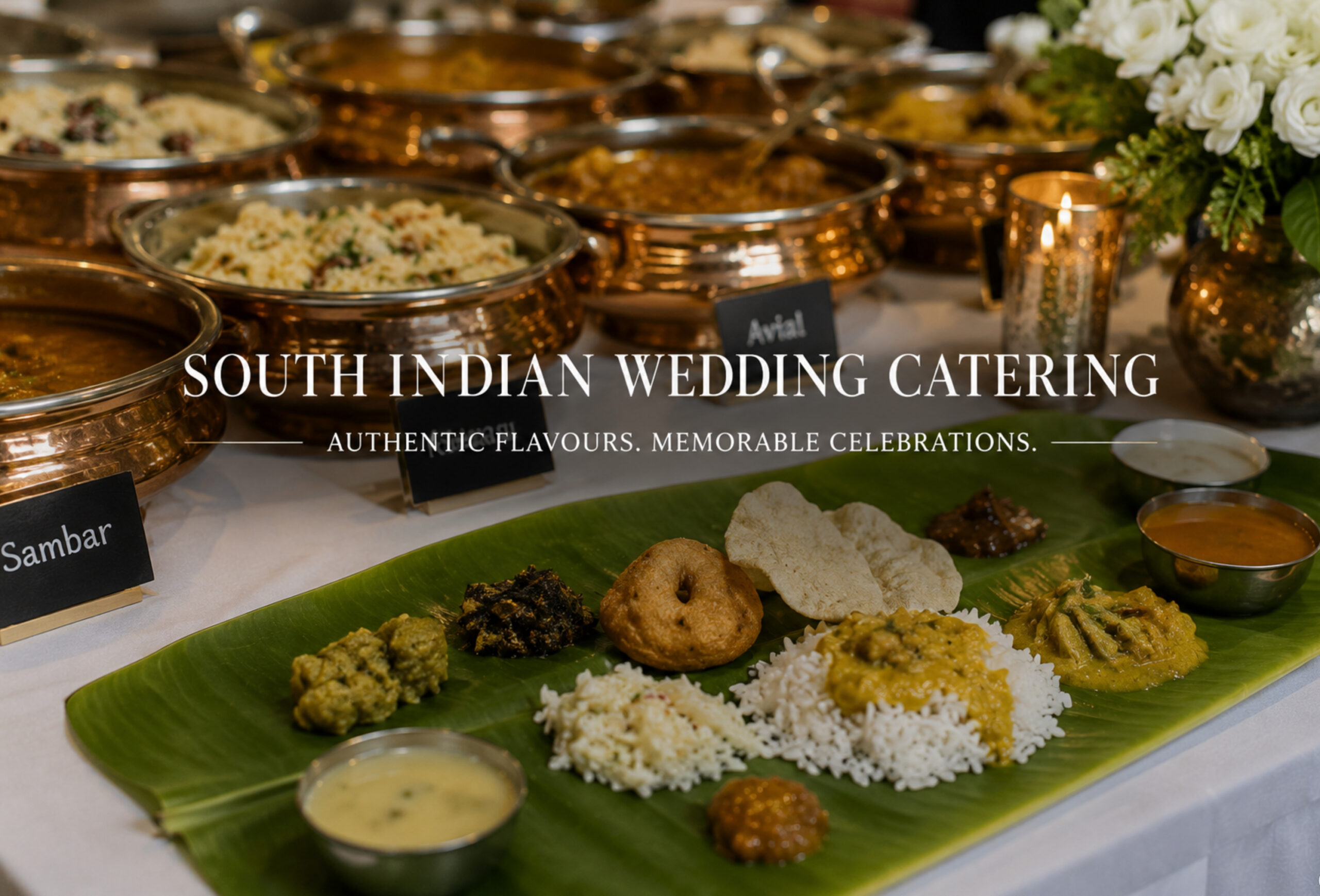
South Indian Wedding Catering in London: A Complete Menu & Cost Guide for 2026
Ask anyone what they remember from a South Indian wedding, and it usually isn’t the stage or the flowers. It’s the food. The queue at the dosa counter. The first spoon of properly made sambar. The payasam that somebody’s aunt insisted was better than last year’s. Food is the part of the day every single guest has an opinion on, and it’s the part they’ll still be talking about months later.
Which is exactly why so many couples find the catering the hardest bit to plan. Venue prices are easy enough to pin down. Catering is where it gets murky — one company quotes per head, another quotes a package, one includes staff and equipment, another charges for them separately. If you’re trying to build a realistic budget, it can feel like comparing things that aren’t really comparable.
So here’s an honest, practical guide to what South Indian wedding catering actually costs in London in 2026 — what drives the price, what a good menu looks like, and where couples tend to over- or under-spend. We cater these weddings for a living, so where we can be specific, we will be.
How much does South Indian wedding catering cost in London?
For most South Indian weddings in London, catering works out at roughly £18 to £70+ per guest in 2026.
At the lower end, a traditional vegetarian buffet for a smaller wedding might land somewhere between £2,000 and £4,000. A larger reception — think 300 guests, live dosa and appam stations, a few Sri Lankan specialities and a proper dessert table — can comfortably run past £15,000.
The honest answer is that the final figure comes down to five things: how many guests you’re feeding, what’s on the menu, how it’s served, where the venue is, and how many staff the day needs. We’ll take each of those in turn, because understanding them is what lets you spend well rather than just spend.
Why catering ends up being one of your biggest costs
Most families start out budgeting carefully. Then the guest list happens.
A wedding planned for 150 quietly becomes 250 once both sides have added their relatives, and food scales directly with that number in a way flowers and photography don’t. In South Indian and Sri Lankan culture, feeding people generously isn’t an add-on to the celebration — it is the celebration. Nobody wants to be the family that ran out of biryani.
That’s worth keeping in mind when you look at the numbers below. Catering typically accounts for 30 to 40% of a total wedding budget, and it’s the single line item guests judge most harshly. It’s not the place to cut aggressively.
As a worked example: a 200-guest wedding choosing a standard buffet usually comes in around £6,000 to £8,000. Add a live dosa station, an appam counter, extra desserts and the staff to run them, and the same wedding can climb well beyond £10,000. Neither is “right” — it depends entirely on the day you want.
A quick word of caution on these figures. They’re genuine market ranges for 2026, but every wedding is different, and the only number that truly matters is the one on a written quote for your guest count, your menu and your venue. Treat the table above as a starting point, not gospel.
What actually drives the price
Guest numbers
This is the big one. The difference between 80 guests and 300 isn’t just more food — it’s more chefs, more serving staff, more equipment, more transport, and sometimes a bigger kitchen setup entirely. Finalising your numbers early is genuinely the easiest way to keep the budget under control, because late additions are where costs quietly balloon.
The menu
A vegetarian menu built around idli, sambar, rasam, poriyal and a good biryani will nearly always offer better value than one leaning on seafood and premium proteins — and it’s no less impressive when it’s done properly. The moment you add fish, mutton, prawns or imported ingredients, the per-head cost climbs. There’s nothing wrong with that; it’s just useful to know which levers move the price.
How the food is served
Most couples focus on what’s being served and forget that how it’s served changes the cost just as much.
Buffet remains the most popular choice for South Indian weddings, and for good reason — it’s efficient for large numbers, offers the most variety, and keeps staffing sensible. Table service feels more formal but needs far more staff, so it costs more. Family-style, where sharing dishes go onto each table, sits somewhere in between and captures that communal, everyone-reaching-in feeling that suits a South Indian meal so well.
The venue
Two identical menus can cost noticeably different amounts depending on the venue. Central London sites often come with access restrictions, parking charges and tight load-in windows. Outdoor and marquee weddings can need a temporary kitchen, extra generators and weather cover — all of which adds up. A venue that’s used to hosting South Asian weddings, with the kitchen space and power to match, almost always makes for smoother, more cost-effective catering.
Staffing
Great food still needs the right team behind it — servers keeping the buffet flowing, chefs manning the live stations, and support staff handling setup and clear-down. The bigger the wedding, the larger that team, and staffing is a real part of the quote rather than an afterthought.
Building the menu: what a South Indian wedding spread looks like
This is the fun part. A well-planned menu can carry a guest from the moment they arrive to the last cup of filter coffee, and the best ones balance the dishes the grandparents expect with a few that’ll surprise the younger crowd.
Starters
Served as guests arrive, these set the tone. Reliable crowd-pleasers include medu vada, mini idli, masala vadai, vegetable cutlets, paneer tikka and gobi manchurian. A mix of the traditional and the modern tends to keep every generation happy.
The main buffet
The heart of the meal. A classic vegetarian spread might run through sambar, rasam, avial, poriyal, vegetable kurma, lemon rice, coconut rice, a vegetable biryani, paneer butter masala and fresh chapati. For families who want non-vegetarian options, chicken biryani, mutton curry, fish fry, pepper chicken and chicken Chettinad are the usual favourites.
Sri Lankan touches
For Sri Lankan families — or mixed guest lists — dishes like rice and curry, a proper chicken curry, dhal, pol sambol, string hoppers and kothu roti add a distinct flavour that guests remember, even the ones trying it for the first time.
Dessert
Payasam is the traditional close, but a dessert table with a few extras never goes unappreciated. This is a small spend that earns a lot of goodwill.
Live food stations: worth the money?
For a lot of couples, yes — and not just for the food. Live stations turn dinner into a bit of theatre, and they’re often where guests linger longest.
The live dosa counter is almost always the busiest spot in the room. Plain, masala, ghee roast, Mysore — freshly made, with proper chutneys and sambar alongside. An appam station with vegetable or chicken stew works beautifully for mixed South Indian and Sri Lankan crowds. A chaat counter (pani puri, bhel puri, sev puri) brings energy and gives people a reason to keep coming back. And for Sri Lankan weddings, a live kothu roti station — with that unmistakable clatter of the griddle — can steal the whole show.
They do add cost, mainly because each station needs its own trained chef. But if there’s one place couples rarely regret spending, it’s here.
Where couples over- and under-spend
A few patterns we see again and again:
The cheapest quote is rarely the cheapest wedding. A low per-head price often leaves out staff, equipment, setup or transport, and those reappear later. Always ask for an itemised breakdown so you’re comparing like with like.
Guaranteed minimums catch people out. Many caterers bill to a guaranteed number, so if you cater for 280 and 250 turn up, you may still pay for 280. Confirm this upfront.
Under-ordering food is a false economy. Plan for slightly more than your headcount on the mains — running short at a South Indian wedding is the one thing nobody forgets. Bread and rice move fast, so build in a little headroom.
Over-decorating the stage, under-investing in food. Elaborate florals are seen once. The food is experienced by everyone, all night. If something has to give, it usually shouldn’t be the catering.
How to keep costs sensible without cutting corners
You can absolutely control the budget without anyone noticing a drop in quality:
Lock your guest list early — even 20 or 30 fewer guests makes a visible difference. Lean on a strong vegetarian buffet as your base and treat premium dishes as highlights rather than the whole menu. Choose seasonal ingredients where you can, and ask your caterer what’s at its best. Avoid last-minute menu changes, which force rushed purchasing. And work with a caterer who does these weddings regularly — experience with portioning, cultural expectations and event logistics is what stops small problems becoming expensive ones on the day.
Frequently asked questions
How much does South Indian wedding catering cost per person in London? Most South Indian wedding catering in London costs between £18 and £70+ per person in 2026. A traditional vegetarian buffet sits at the lower end; a premium menu with seafood, live dosa stations and dedicated service staff sits at the top.
What’s included in a wedding catering package? Typically food preparation, delivery, buffet setup, serving equipment, the food service itself and clear-down. Premium packages may add live cooking stations, event coordination and extra serving staff. Always ask for a written breakdown of what’s in — and what isn’t.
Is buffet catering cheaper than table service? Usually, yes. A buffet needs fewer staff and serves large numbers more efficiently, which is why it’s the most popular format for South Indian and Sri Lankan weddings in London.
How far in advance should we book? Six to twelve months is sensible, and sooner for peak wedding-season dates, which book up fast. Booking early also leaves room for tastings and menu planning.
Can you cater fully vegetarian — or vegan — menus? Absolutely. Vegetarian catering is central to many South Indian wedding traditions, from idli and dosa to sambar, rasam and payasam. Vegan and other dietary requirements can be accommodated with a little notice.
Are live dosa stations really worth the extra cost? For most couples, yes. They create a fresh, interactive experience that appeals to every generation, and they’re consistently one of the most popular parts of the reception.
Planning a South Indian wedding in London?
Whether you’re planning a traditional Tamil wedding, a Sri Lankan reception or a modern South Asian celebration somewhere in between, the right catering partner makes the whole day easier — and a great deal more memorable.
At The Clay Oven, we’ve spent years cooking for South Indian and Sri Lankan weddings across London, from intimate family gatherings to receptions in the hundreds. We’ll help you build a menu that reflects your family’s traditions, fits your budget honestly, and gives your guests something to talk about long after the day is done.