


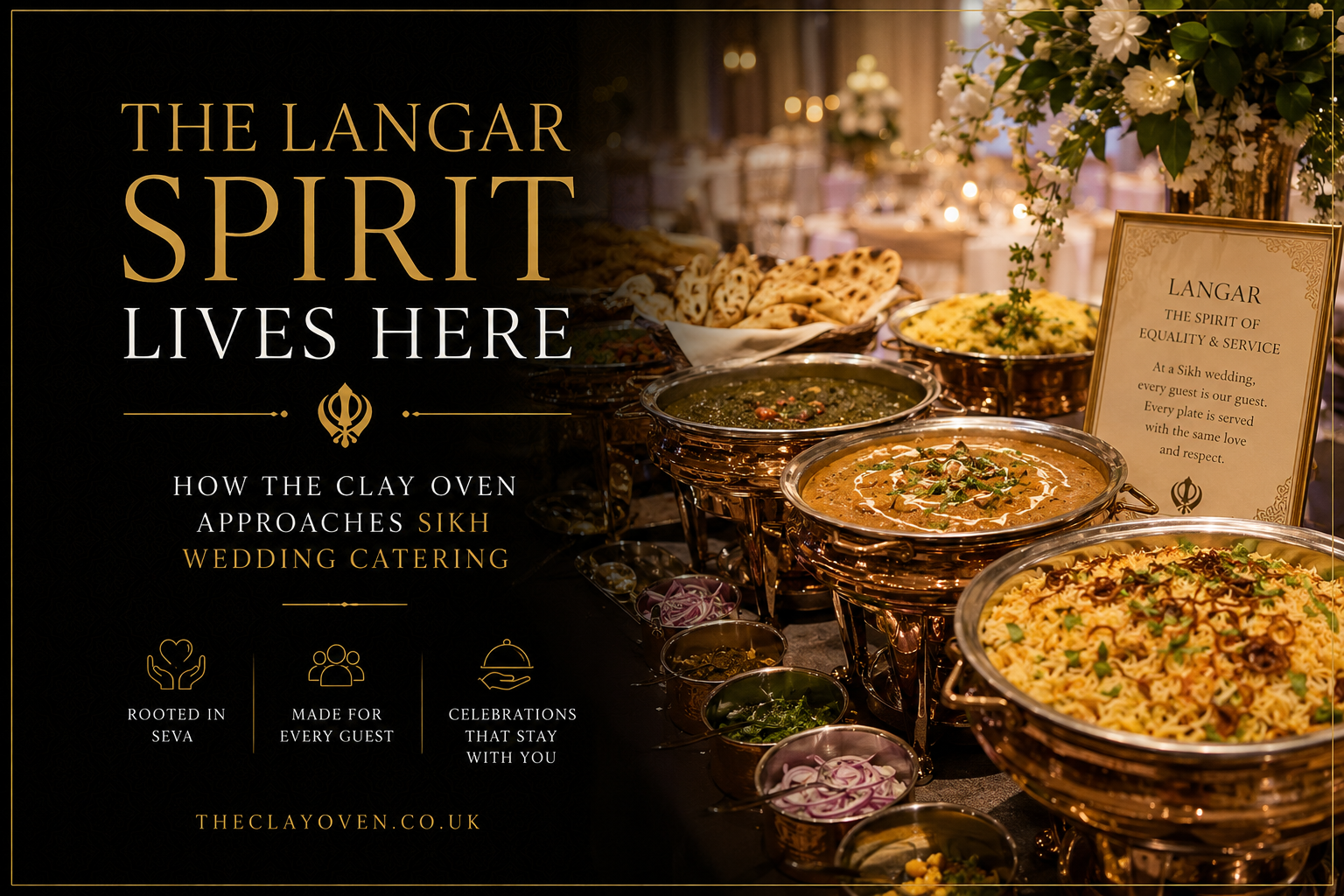
The Langar Spirit Lives Here: How The Clay Oven Approaches Sikh Wedding Catering (March 2026)
The Langar Spirit Lives Here: How The Clay Oven Approaches Sikh Wedding Catering
Punjabi wedding catering · Sikh wedding food UK · Anand Karaj reception · London · Wembley · Hertfordshire
There is a word that Punjabi families use when they talk about the way food should be served at a wedding: dil khol ke. Open-heartedly. It does not mean serve a lot of food — though at a Sikh wedding you will always do that. It means serve it with the kind of warmth that makes every guest feel not merely fed, but honoured.
This distinction sits at the very heart of how The Clay Oven approaches Sikh wedding catering. In over four decades of serving some of the most significant celebrations in London’s Punjabi community, we have come to understand that food at a Sikh wedding is never simply a practical requirement. It is a spiritual expression. It is community, made edible. And it carries, in every dish that leaves the kitchen, the echo of one of Sikhism’s most profound and enduring practices: the langar.
This blog is about that spirit — where it comes from, what it means in the context of a modern Sikh wedding reception in the UK, and how The Clay Oven has built its entire catering philosophy around honouring it.
What Langar Actually Means — And Why It Matters at Your Wedding
At every Gurdwara across the world, in Amritsar and Southall and Wembley and Singapore, the same thing happens every single day. A community kitchen — the langar — opens its doors and prepares a vegetarian meal that is offered freely to everyone who walks in, regardless of their faith, their background, their wealth, or their status. No one sits above anyone else. No one’s plate is more generously filled than another’s. There is no VIP table in the langar hall.
This practice, instituted by Guru Nanak Dev Ji in the fifteenth century, encodes within it a radical and beautiful idea: that the act of feeding another person is, at its core, an act of equality. Of service. Of love expressed through something as immediate and as necessary as food.
Langar is not charity. It is seva — selfless service. And the spirit of it is that the person serving gains as much as the person eating. They are, in that moment, equal participants in something sacred.
When a Sikh family hosts a wedding reception for four hundred guests, they carry this understanding with them. The scale changes, the setting changes, the menu expands enormously beyond dal and roti. But the animating principle remains constant. Every guest at a Sikh wedding should feel that the food was prepared and offered with the same open-hearted care that has characterised community feeding in Sikh culture for five centuries.
What this means in practical terms for the caterer is that abundance is not optional, but neither is it sufficient on its own. Abundance without warmth is mere provision. The langar spirit requires both — generous quantity and genuine care in how it is prepared and served.
The Rhythm of a Sikh Wedding — and How Catering Follows It
A traditional Sikh wedding is rarely a single event. It is, more accurately, a constellation of celebrations — typically spanning two to three days — each with its own emotional register, its own guest composition, and its own catering requirements. Understanding this rhythm is the first thing any experienced Sikh wedding caterer must do.
The Mehndi or Sangeet — The Celebration Before
The evening before the Anand Karaj, the families gather — often separately, though increasingly together — for the Mehndi celebration. This is a night of music, laughter, dancing, and the particular joy that comes from the anticipation of something transformative on the horizon. The atmosphere is warm and informal. Guests arrive in waves. Children run underfoot. The elderly sit together and reminisce.
Catering for this evening must match that energy. It should feel generous without being overwhelming, festive without being formal. Live chaat counters are a natural fit — the theatre of watching a chaat wala pile Papdi Chaat, drizzle tamarind, scatter sev, and hand over a plate that disappears in three bites creates a kind of informal joy that a static buffet simply cannot replicate. Pakora platters passed through the crowd, fresh Pani Puri served to order, hot samosas with three chutneys — these are the foods of this evening.
Lighter main preparations — Punjabi-spiced wraps, mini portions of Dal Tadka with fresh roti, Indo-Chinese bites that the younger guests gravitate towards — should complement the chaat stations without competing with them. The Mehndi table is not the night for the formal biryani. That moment comes later.
The Anand Karaj Morning — Presence Before Food
The ceremony itself — the Anand Karaj, meaning ‘blissful union’ — is conducted in the presence of the Guru Granth Sahib, the eternal living scripture of the Sikh faith. The couple circles the scripture four times as the Laavan, the wedding hymns, are sung. It is a deeply moving and spiritually weighty experience.
The caterer’s role during the Anand Karaj is to be ready, not visible. Preparation happens quietly, efficiently, and completely behind the scenes — so that when the ceremony concludes and guests begin moving towards the reception space, they encounter warmth, abundance, and welcome. Not the organised chaos of a team still setting up.
The twenty minutes after the Anand Karaj ends are, in our experience, some of the most important in the entire celebration. Guests emerge from a sacred and emotionally significant experience. What they encounter first — the smell of food being prepared, the sight of fully dressed service stations, the immediate offer of welcome drinks — sets the emotional tone for everything that follows. At The Clay Oven, our teams are fully positioned and service-ready before the ceremony concludes. This is non-negotiable.
The Wedding Reception — Where the Langar Spirit Comes Fully Alive
The evening reception is where everything scales up. Guest lists of 300 to 500 are common within the Punjabi Sikh community — not as extravagance, but as a genuine reflection of family and community ties that run deep across generations. A family that has lived in the UK for forty years has woven itself into networks that span Gurdwaras, neighbourhoods, professional circles, and the web of relationships that Punjabi culture calls biradari — extended community.
Catering for this scale requires infrastructure, experience, and a team that doesn’t merely cope with large numbers but thrives in them. Our Wembley banqueting suites were built for exactly this — with kitchen capacity, service layout, and venue infrastructure designed to serve 500 guests as fluently as 150.
The evening reception menu is the moment when the full breadth of Punjabi culinary tradition should be on display. Not as a showcase, but as a genuine act of hospitality — a table so complete, so carefully composed, that every guest, from the youngest cousins to the most distinguished of the elders, finds something that speaks directly to them.
The Sikh Wedding Reception Menu — Dishes That Carry Meaning
The Punjabi wedding menu is one of the great expressions of north Indian culinary tradition — rich, complex, built on spice blends and cooking techniques refined over generations. But at a Sikh wedding, certain dishes do more than satisfy hunger. They connect guests to identity, to memory, to family. They are cultural objects as much as they are food.
Dal Makhani — The Soul Dish
There is no single dish more closely associated with the Punjabi table than Dal Makhani. Black lentils and kidney beans, slow-cooked overnight, enriched with butter and cream, finished with a tarka of garlic and whole spices — this preparation has a depth of flavour that is impossible to rush and immediately apparent to anyone who knows it well. Elders at a Sikh wedding will judge the quality of the caterer, in part, by this dish.
At The Clay Oven, our Dal Makhani is prepared through a minimum of twelve hours of slow cooking, using proportions and technique our chefs have refined through decades of practice. It arrives at the service station thick, dark, intensely flavoured, and properly enriched. It is the kind of dal that prompts guests to seek out the kitchen team to offer their compliments.
Biryani — Ceremony Within a Dish
Dum biryani — the technique of layering partially cooked spiced meat with fragrant rice, sealing the vessel, and finishing through its own steam — is a dish that rewards patience and punishes shortcuts. When executed correctly, each grain of basmati has absorbed the perfume of whole spices, saffron, and caramelised onion without collapsing into softness. The meat is yielding but present. The aroma, when the seal is broken, is extraordinary.
Served at a Sikh wedding reception, a properly made dum biryani carries its own ceremony. The act of serving it — breaking the crust, layering the rice and meat, scattering the garnish of fried onions and fresh coriander — has a theatricality that guests respond to instinctively. Our chefs have been preparing biryani to this standard for four decades.
Tandoor Preparations — Fresh, Living Fire
Live tandoor stations are, for many guests, the defining sensory experience of a Sikh wedding reception. The heat radiating from the clay oven, the sound of naan being slapped against its walls, the sight of seekh kebabs and chicken tikka being retrieved on long metal skewers — these connect guests to a cooking tradition that stretches back centuries and is, for many in this community, inseparable from the idea of celebration itself.
Our marinades for chicken tikka and seekh kebab have been developed to produce the specific char and smokiness that distinguishes genuinely tandoor-cooked meat from oven-roasted approximations. Naan is made to order and served immediately: warm, pliable, with the slightly blistered surface that tells you it came directly from the clay wall of the oven.
Sarson Da Saag and Makki Di Roti — A Dish That Carries Winter Home
For Sikh weddings held between November and February, Sarson Da Saag — mustard greens slow-cooked with spinach, finished with a generous knob of butter and a tarka of garlic, served alongside dense golden Makki Di Roti — is perhaps the most emotionally resonant dish on the menu. It is the food of Punjabi winters, of villages and farms and cold evenings, of the kind of rootedness that the diaspora has never quite lost its feeling for.
When an elderly guest at a Wembley wedding reception is served this dish and it tastes the way it should — the greens properly broken down, the roti slightly coarse-textured, the butter generous — the response is often silence first, and then something that looks very much like gratitude. This is what food at a Sikh wedding can do when it is prepared with genuine understanding.
The Vegetarian Table — Not a Concession, a Centrepiece
Sikh dietary practice varies widely between families. Some maintain fully vegetarian menus at wedding celebrations as a matter of religious principle. Others serve both. In either case, the vegetarian dishes must be treated as equal principals on the table, not supporting cast.
Our vegetarian Punjabi preparations — Paneer Tikka Masala, Kadai Paneer, Aloo Gobi enriched with whole spices, Chana Masala with its slow-developed depth — are not afterthoughts to a non-vegetarian menu. They are dishes we prepare with the same care and technique as everything else on the table. At a Sikh wedding, a significant proportion of guests may be eating exclusively from the vegetarian section, and their experience of the food should be no less exceptional for it.
The Sweet Moment — Mithai, Desserts, and the Prasad Connection
Every Sikh ceremony concludes with the distribution of Karah Prasad — a warm, dense halva made from equal weights of flour, ghee, and sugar, blessed and shared without distinction among all present. It is one of Sikhism’s most direct expressions of equality: the same sweet, in the same quantity, given to every person in the Gurdwara.
The wedding dessert table echoes this spirit in a more elaborate register. Gulab Jamun in warm syrup. Rasmalai — soft milk-solid dumplings floating in chilled saffron cream — which has, for many British Punjabi families, become the essential wedding dessert by which all others are measured. Gajar Halwa in winter, with its caramelised depth and cardamom warmth. Kulfi in mango and pistachio served near the dance floor. And Jalebi, freshly fried and dripping with sugar syrup at a live station that draws a crowd at 11pm without fail.
These are not merely sweet courses. They are, in the context of a Sikh wedding, expressions of the same generous, joyful spirit that has defined this community’s relationship with food for generations.
How The Clay Oven Carries the Langar Spirit Into Every Wedding We Cater
Understanding the cultural context of Sikh wedding catering is one thing. Building a catering operation that expresses it consistently — across events of 300 to 500 guests, across multiple consecutive days, at venues ranging from Wembley to country estates in Hertfordshire and Buckinghamshire — is something else entirely.
Abundance is planned, not assumed. We plan Sikh wedding menus using actual consumption data from comparable events rather than generic per-head estimates. Popular dishes are catered for more generously than industry averages because we know from experience how quickly they move at Punjabi receptions. Service stations are checked every ten minutes during peak service, and kitchen communication pathways are established so that fresh batches reach guests quickly when dishes begin to deplete.
Service is warm, not transactional. The staff who work our Sikh wedding events understand that offering food at a Sikh wedding carries particular cultural significance. They approach guests proactively, attentively, and with the kind of genuine warmth that guests recognise and carry home with them. Our event managers are experienced in the specific rhythms and priorities of Punjabi Sikh celebrations, not simply in events catering in general.
Quality holds from first service to last. At a large reception, the food at 9pm should be indistinguishable in quality from the food at 7pm. This requires kitchen timing, holding technique, and service management that prevents any dish from sitting beyond the point at which it is at its best. The guest who comes to the buffet an hour after doors open deserves exactly the same experience as the one who was first in line.
Dietary requirements are remembered, not just noted. At Sikh weddings, dietary requirements range from full vegetarianism to Jain-observant menus that exclude onion and garlic, from halal requirements where the wedding bridges Sikh and Muslim family traditions, to individual allergies and intolerances. Our systems carry these requirements across the full duration of a multi-day celebration — so the elderly relative who requires a specific plate at the Mehndi receives the same consideration at the reception without her family needing to ask again.
Forty years of community trust. The Clay Oven has been part of London’s Punjabi Sikh community for over four decades. Many of the families who come to us for their weddings today were brought to our events as children by their own parents. This continuity of relationship — built across generations — is our most important credential. It reflects not simply culinary skill but the kind of cultural understanding that can only come from years of genuine engagement with a community and its values.
Where Sikh Weddings Come to Life: Our Venues
The langar spirit does not change between venues, but the practical expression of it is shaped by the space in which a celebration takes place.
The Clay Oven Banqueting Suites, Wembley — our home for over forty years, built for the scale of Sikh wedding celebrations. With capacity for up to 500 guests, kitchen infrastructure designed for high-volume professional catering, and proximity to the Gurdwaras, communities, and transport links that matter to this celebration, it is the natural choice for families hosting large-scale receptions. It is a venue that needs no introduction within the Punjabi community.
Hunton Park, Hertfordshire — a Georgian mansion set within thirty-three acres of landscaped grounds, licensed for ceremonies and with a garden marquee accommodating up to 500 guests. It offers Sikh couples the opportunity to host their celebration in surroundings of exceptional beauty, with the full catering capability that these occasions demand.
Denham Grove, Buckinghamshire — a country estate between London and the Chilterns, with multiple licensed event spaces that allow different elements of a multi-day Sikh wedding to occupy distinct, atmospherically appropriate environments.
The Food You Serve at Your Wedding Will Be Remembered
In Punjabi culture, there is a quiet understanding that the food at a wedding is among the first things guests discuss afterwards. Not as gossip, but as a genuine reflection of what the celebration was — what values the hosting family expressed, what kind of love they extended to the people who came to mark this moment with them.
A Sikh wedding where the food is extraordinary becomes a reference point. Guests carry it forward in conversation for years. The Dal Makhani that tasted exactly right. The biryani that had the whole room talking. The freshly fried Jalebi at midnight that nobody expected and everybody remembered. These are the details that transform a celebration from an event into a story.
At The Clay Oven, we have been helping Punjabi Sikh families tell these stories for over forty years. The langar spirit — food as service, as generosity, as the equal welcome extended to every person who walks through the door — is not a philosophy we adopted. It is one we have grown up with, through decades of being trusted to be part of the most significant celebrations in this community’s life.
It is a privilege we do not take lightly.
Planning a Sikh wedding in London or the Home Counties? The Clay Oven offers Punjabi wedding catering across our Wembley banqueting suites, Hunton Park in Hertfordshire, and Denham Grove in Buckinghamshire — from intimate Mehndi gatherings to 500-guest evening receptions. Call us on 020 8903 8800 or visit theclayoven.co.uk to begin the conversation.