


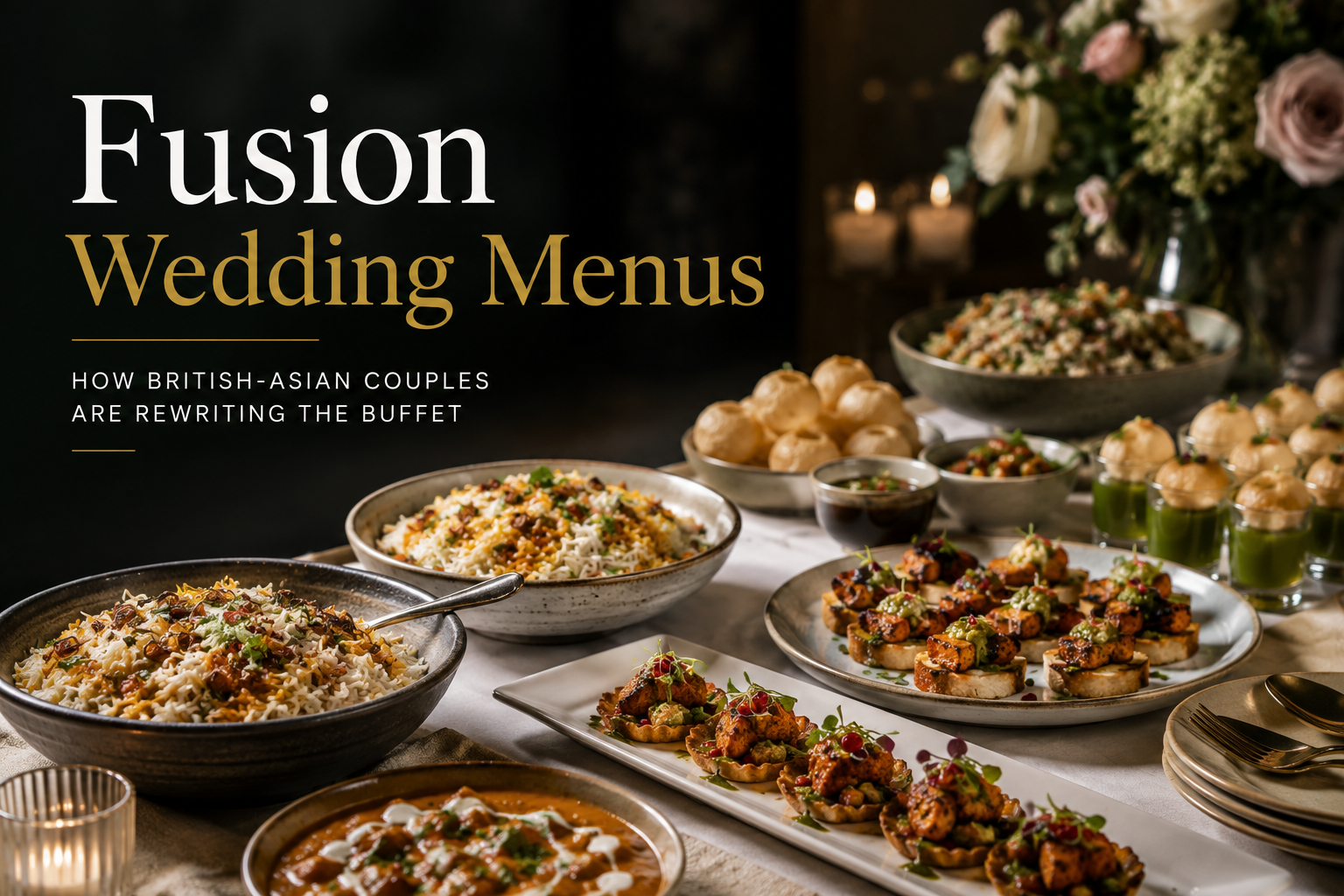
Fusion Wedding Menus: How British-Asian Couples Are Rewriting the Buffet
Ask any wedding caterer what’s changed most in the last five years, and the answer isn’t the flowers or the fireworks — it’s the buffet. British-Asian couples getting married today grew up on two food cultures at once: their grandmother’s Sunday cooking and a Friday night takeaway with mates. Increasingly, they want their wedding menu to say both things at the same time.
That’s fusion wedding catering. Not a gimmick, not a watered-down version of a “proper” Indian wedding menu — a deliberate, considered blend of South Asian tradition and contemporary British (or global) flavour, built by couples who refuse to choose between their two identities on the biggest day of their lives.
Here’s what that actually looks like on the plate, and why it’s becoming the norm rather than the exception.
Why Fusion Menus Are Having a Moment
Three things are driving this shift.
The couples themselves have changed. Many British-Asian brides and grooms today are second or third generation. They’ve eaten at Nando’s as often as they’ve eaten dal at home, and their friendship groups are genuinely mixed — culturally, religiously, and in terms of what they consider “normal” wedding food.
Wedding guest lists are more diverse than ever. A modern Asian wedding might include the groom’s university housemates, the bride’s colleagues, and elderly relatives who’ve never eaten anything but home-style Punjabi food — all under one marquee. A fusion menu is often the most practical way to make every single one of those guests feel fed, not just accommodated.
Social media has raised the bar on presentation. Live stations, plated canapés, and Instagram-worthy dessert tables have become expected, not exceptional — and fusion dishes tend to photograph beautifully because they’re novel.
What Fusion Actually Looks Like on the Menu
Fusion doesn’t mean abandoning tradition — the best fusion menus use it as the anchor. A few examples we’re seeing requested again and again:
- Tandoori-spiced canapés with a British twist — think tandoori chicken vol-au-vents or paneer tikka bruschetta served during the drinks reception, before the formal meal even begins
- Curry-spiced Sunday roast elements — a masala-rubbed roast lamb or a chai-spiced dessert that nods to a British classic while staying rooted in South Asian spice
- Indo-Chinese live stations sitting next to a traditional thali counter — Hakka noodles and chilli paneer served a few feet from Punjabi classics, so guests can build their own plate however they like
- Mocktail and chaat bars — pani puri shots, bhel poori cones, and spiced margarita mocktails served together as an interactive starter course
- Western-style plated starters with Asian flavour profiles — a seared salmon with a tamarind glaze, or a burrata plate finished with a coriander-chilli oil
The pattern across all of these: the base technique or format is often familiar to a Western palate, but the flavour is unmistakably South Asian. Nothing is diluted — it’s layered.
The Non-Negotiables Couples Still Insist On
Even the most fusion-forward couples we work with are firm about certain things staying exactly as they should be:
- The core wedding feast stays traditional. Fusion tends to live in the starters, canapés, and live stations — not in the main buffet, which is usually still built around the family’s regional cuisine (Punjabi, Gujarati, Sri Lankan, and so on).
- Dietary and religious requirements come first. Halal, Jain, and vegetarian guidelines aren’t negotiable just because a menu is going “fusion” — good caterers build the innovative dishes around those rules, not around them.
- Elders are never an afterthought. A menu that excites twenty-something guests but leaves grandparents with nothing familiar to eat isn’t a fusion menu — it’s a missed brief.
How to Brief Your Caterer for a Fusion Menu
If you’re planning a fusion wedding menu, the conversation with your caterer works best when you go in with a few things clear:
- Pick your “fusion moments” deliberately. Rather than fusing everything, choose two or three touchpoints — the canapés, one live station, or the dessert table — and let the rest of the meal stay traditional. This keeps the menu coherent rather than chaotic.
- Talk through your guest mix honestly. Tell your caterer roughly how many guests are unfamiliar with South Asian food versus how many are expecting an authentic family-style spread. This shapes portioning and dish selection far more than most couples expect.
- Ask to taste before you commit. Fusion dishes are the ones most likely to miss the mark if untested — a tasting session is non-negotiable here.
- Don’t fuse for the sake of it. The best fusion dishes solve a real problem — a mixed guest list, a modern couple’s own story — rather than existing purely for novelty.
Why It Matters Who You Book
Fusion catering only works when the caterer genuinely understands both sides of the plate. It’s easy to bolt a “fusion” label onto a menu and call it modern; it’s much harder to build dishes that respect regional Indian, Pakistani, Bangladeshi, or Sri Lankan tradition while confidently reworking them for a contemporary British wedding.
At The Clay Oven, this is where four decades of South Asian catering experience earns its keep — our chefs know the traditional dishes well enough to know exactly how far they can be pushed, and where the line is. Whether you want a handful of fusion canapés alongside a classic Punjabi buffet, or a full reimagining of your reception menu, we’ll build it around your guest list, your families, and your story — not a trend.
Planning a wedding menu that reflects who you both are? Get in touch to talk through your menu with our team.