


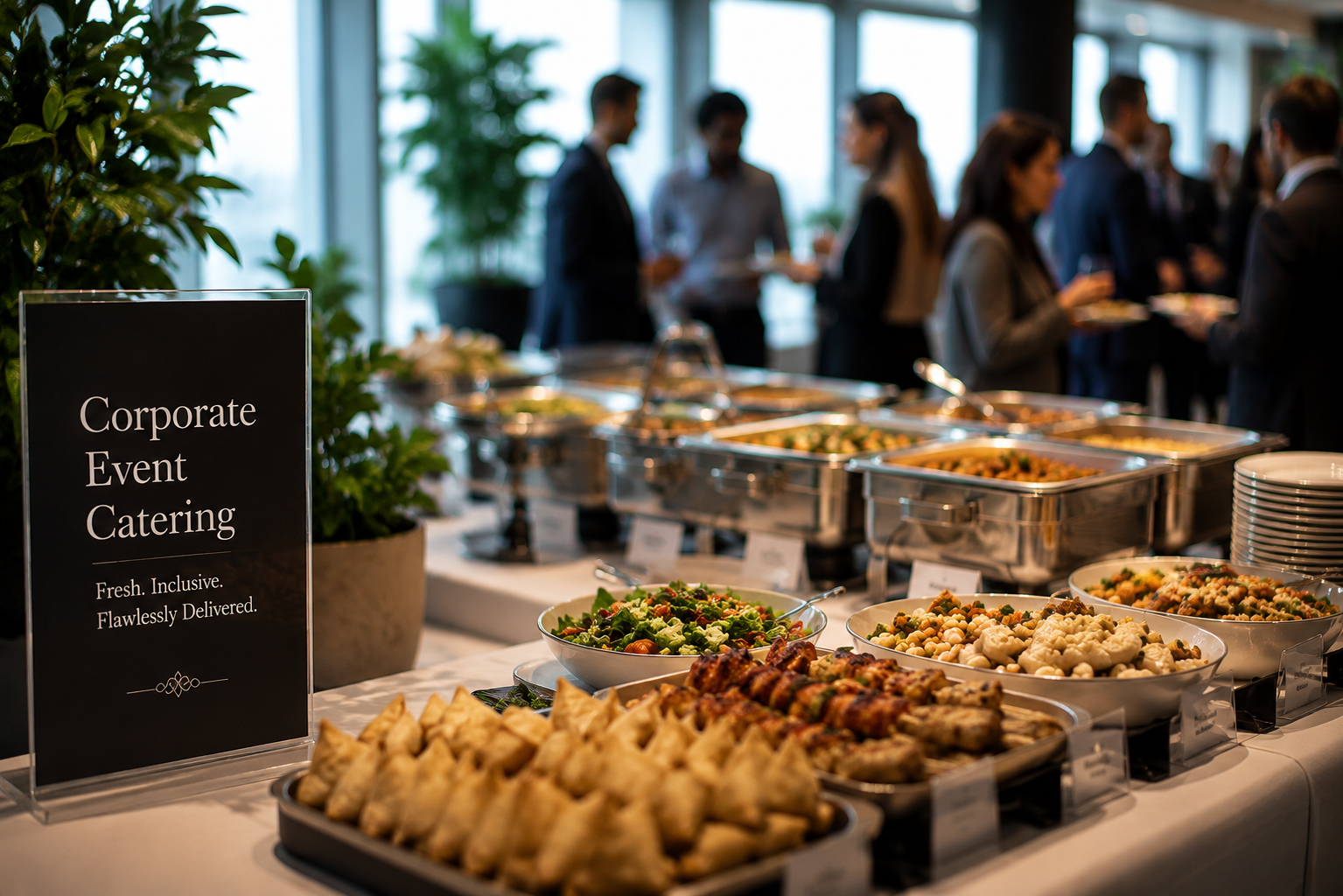
Corporate Event Catering in London: 8 Menus That Work for a Mixed Office
Feeding a modern London office is harder than it looks. One team is vegetarian, someone only eats halal, two people are gluten-free, and there’s always at least one person who’ll quietly eat nothing if the options don’t suit them. Get it wrong and half the room drifts off to the nearest Pret. Get it right and the food barely gets a mention — which, for corporate catering, is exactly the point. It should support the day, not compete with it.
After 40+ years catering everything from boardroom lunches to 800-seat award dinners, we’ve learned that the best corporate menus aren’t the fanciest. They’re the ones that quietly work for everyone in the room. Here are eight that consistently do.
1. The Breakfast Working Session
Early starts need food that wakes people up without putting them to sleep by 10am. A good corporate breakfast spread leans on things people can pick up between conversations: fresh fruit platters, yoghurt and granola pots, warm pastries, and something hot and substantial like spiced scrambled eggs or a masala omelette station.
The trick is balance. Pastries alone and the room crashes mid-morning. Add protein and fibre and people stay sharp through the first two sessions. Keep tea, filter coffee and a couple of juices flowing throughout, not just at the start.
Works well for: breakfast meetings, training days, early sales kick-offs.
2. The Finger Buffet That Doesn’t Need a Fork
Some meetings never really stop — people eat standing, plate in one hand, phone in the other. For those, everything needs to be handheld and mess-free. Think samosas, paneer or vegetable pakoras, seekh kebabs, mini wraps, and bite-sized tikka skewers, all served with chutneys on the side rather than poured over.
Nothing that drips, nothing that needs cutting, nothing that leaves a plate looking sad after five minutes. A strong finger buffet keeps a networking room moving instead of anchoring everyone to a table.
Works well for: networking sessions, product launches, informal client visits.
3. The Fork Buffet for a Proper Lunch Break
When the agenda actually pauses for lunch, people want something that feels like a real meal. A fork buffet gives you room for hot mains — a chicken curry, a paneer or chana dish, a rice, a dal, warm naan — alongside a couple of fresh salads. Everything’s eaten seated with a fork, no knife required, no carving station holding up the queue.
This is the workhorse of office catering because it scales. The same format feeds a table of twelve or a room of two hundred, and it’s easy to keep a clear vegetarian half and a clear meat half so nobody has to ask what’s in what.
Works well for: all-day conferences, department away days, mid-size team lunches.
4. The All-Vegetarian Spread (That Meat-Eaters Won’t Notice)
Plenty of offices default to vegetarian for the whole room — it sidesteps most dietary landmines in one move, and done well, nobody feels short-changed. The key is variety and heft: a rich paneer dish, a hearty lentil or chickpea curry, a vegetable biryani with real depth, and sides that carry flavour rather than just filling space.
The failure mode here is the sad “vegetarian option” that’s clearly an afterthought. A menu built vegetarian from the ground up avoids that entirely. Done right, the carnivores go back for seconds without realising there was no meat.
Works well for: mixed-faith offices, sustainability-minded companies, guaranteed inclusivity.
5. The Fully Halal Menu, No Asterisks
For a lot of London teams, halal isn’t a side note — it’s the baseline that lets everyone eat from the same table. Serving a fully halal menu means no separate trays, no “the chicken’s fine but not the lamb,” no quiet exclusion. Everyone shares the same spread, which is half the point of eating together at work.
A strong halal corporate menu doesn’t feel limited: tandoori chicken, lamb curry, seekh kebabs, biryani and a full range of vegetable dishes all sit comfortably within it. If it matters to your team, ask your caterer directly about their sourcing and certification before you book.
Works well for: diverse offices, client events where you can’t predict guests’ needs.
6. Canapés for the Client-Facing Evening
When the event is about impressing someone — a client dinner, an award evening, a partnership announcement — canapés set the tone before anyone sits down. The standard is high: each bite should look considered and land in one mouthful. Think miniature tikka bites, delicate pakora spoons, chaat served in small cups, all passed on trays during the drinks reception.
Canapés also solve the awkward gap between arrival and the main meal, keeping guests fed and relaxed while photos or speeches run over. Pair five to eight varieties with a drinks package and the room settles itself.
Works well for: award dinners, client receptions, senior stakeholder events.
7. The Three-Course Sit-Down for the Formal Occasion
Some occasions call for everyone seated, served, and looking after their guests properly. A three-course dinner — a plated starter, a main with a clear vegetarian alternative, and a dessert — brings a level of polish that a buffet can’t. It’s the format for the evenings where the food is part of the message.
The thing to plan carefully is dietary alternatives. Every guest with a restriction should get a dish that looks like it was designed for them, not a plain plate assembled at the last minute. That’s the difference between catering that impresses and catering that merely feeds.
Works well for: award dinners, annual celebrations, formal client hospitality.
8. The Grazing / Sharing Table for Team Days
For a relaxed all-hands or a team celebration, a sharing table changes the mood in the room. Everything laid out generously in the middle — breads, dips, salads, marinated vegetables, kebabs, chutneys — and people help themselves and talk while they do it. It’s less formal than a buffet line and it naturally gets people mingling instead of queuing.
It also flexes beautifully around headcount. A table that looks abundant for thirty scales up for a hundred without changing its character, and the visual generosity does a lot of quiet work for company morale.
Works well for: team socials, milestone celebrations, casual company events.
How to Choose the Right One
Match the menu to the moment, not the other way round. A quick internal meeting doesn’t need canapés; a client award evening shouldn’t get a fork buffet. Before you brief a caterer, get clear on three things:
- The headcount and how firm it is. Fluctuating numbers change everything from format to cost per head.
- The dietary map of the room. Vegetarian, halal, vegan, gluten-free, nut allergies — the earlier your caterer knows, the better everyone eats.
- How the day actually flows. People eating on their feet between sessions need different food from people taking a proper break.
Get those three right and the food does its job: it keeps the room fed, focused and impressed, without ever becoming the thing people had to work around.
Catering a Corporate Event in London?
The Clay Oven has spent 40+ years designing bespoke corporate menus for London businesses — from breakfast meetings to three-course award dinners for up to 800 guests, with venues at Wembley, Denham Grove and Hunton Park. Every menu is built around your team, your dietary needs and the way your event runs.