


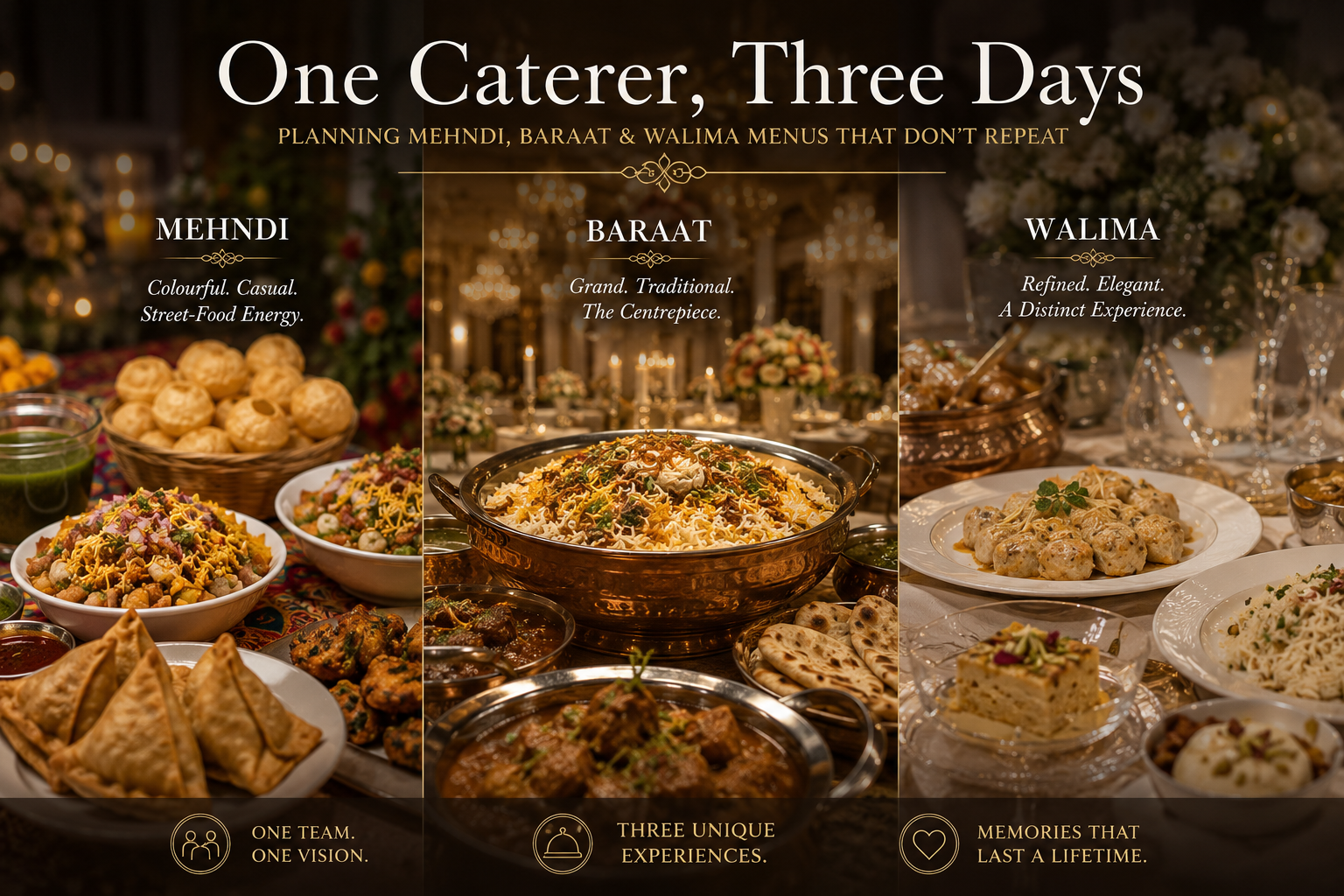
One Caterer, Three Days: Planning Mehndi, Baraat & Walima Menus That Don’t Repeat
Here’s a problem most couples don’t see coming until it’s too late: a lot of your guests come to all three events. The same aunties, the same cousins, the same family friends who were at the Mehndi are back for the Baraat and again for the Walima. And if they’re served biryani three nights running, they’ll notice — and they’ll mention it.
Planning a Pakistani wedding across three days isn’t just about serving good food once. It’s about building three distinct menus that each feel like their own occasion, while still working as one coherent whole. Do it right and every event has its own character. Do it wrong and by the Walima, people are quietly wishing they’d stayed home. The good news: keeping one caterer across all three days is exactly what makes the difference — because someone is looking at the full arc, not just tonight’s dinner.
Why One Caterer Across Three Days Actually Helps
It’s tempting to think spreading your events across different caterers gives you variety. In practice, the opposite is true. When one team plans all three menus together, they can deliberately vary the mains, rotate the proteins, and make sure the biryani that stars at the Baraat doesn’t quietly reappear at the Walima.
A single caterer also holds the through-line that guests feel without naming: consistent quality, consistent halal standards, consistent service. You brief your dietary requirements, family recipes and spice preferences once, not three times. And on the practical side, coordinating one team across three days is far less stressful than managing three separate relationships in the same tense week. This is one of the quiet advantages of booking an established team — the planning happens across the whole event, not in three disconnected pieces.
Day One — Mehndi: Colourful, Casual, Street-Food Energy
The Mehndi is the most relaxed of the three. People are sitting on the floor, music’s playing, hands are being decorated — nobody wants a heavy, formal plated dinner weighing the night down. This is where street food earns its place.
Lean into variety and informality: chaat papdi, gol gappay, chana chaat, samosas and pakoras, chicken tikka off the grill, seekh kebabs, and warm naan straight from the tandoor. Live stations work brilliantly here — a chaat counter or a grill people can gather around adds theatre and keeps the energy up. Keep the sweets light and colourful too: think jalebi, gulab jamun, and a kulfi cart rather than a full formal dessert course.
The Mehndi menu should feel like the fun, high-energy start of a celebration — small plates, lots of choice, nothing that ties people to a chair.
The rule for the night: grazing over grandeur. Save the showpiece mains for later.
Day Two — Baraat: The Grand, Traditional Centrepiece
The Baraat is the main event and the menu should feel like it. This is the night for the full, generous, traditional Pakistani spread — the one the elders will judge and the one guests will remember longest.
This is where the slow-cooked, deeply traditional dishes belong: a proper dum-cooked biryani, nihari or a rich lamb karahi, chicken handi, a substantial vegetable dish for balance, dal, and fresh tandoori breads. Because this is the event where you’re deliberately serving your signature biryani, that’s exactly why you don’t repeat it at the Walima. The Baraat is its moment.
Presentation matters more here than on the other two nights. Whether you go for a lavish buffet or a served banquet, the spread should look abundant — depleted dishes or long queues at a Baraat reflect on the family in a way that lingers. Generosity is the whole point.
The rule for the night: this is the showpiece. Bring out the dishes people will talk about for years.
Day Three — Walima: Refined, Generous, But Distinctly Different
By the Walima, your repeat guests have already had street food and a grand traditional feast. The mistake is to simply run the Baraat menu again. The Walima, hosted by the groom’s family, deserves its own identity — refined and generous, but pointing in a different direction from Night Two.
The move is to shift the flavour profile rather than repeat it. If the Baraat led with a heavy lamb karahi and biryani, the Walima might lead with a creamy shahi korma, a malai boti or reshmi kebab, a lighter pulao instead of a full biryani, and a different vegetable centrepiece. A more formal, plated service also helps the Walima feel like a distinct, elevated occasion rather than a second helping of the night before. Finish with a proper dessert course — a shahi tukda, kheer or a considered mithai table — that the earlier events deliberately held back on.
The rule for the night: same generosity, different direction. Nobody should feel they’ve eaten this meal already.
The Simple Framework: No Dish Appears Twice
If you take one thing from this, make it this planning principle. Across the three days, map your proteins and your headline dishes on a single sheet and make sure nothing repeats:
- Mehndi — small plates and street food; grilled and fried items; light, colourful sweets.
- Baraat — the grand traditional spread; your signature biryani and a rich slow-cooked main; abundant presentation.
- Walima — a refined, differently-spiced menu; lighter rice, creamier mains, and the dessert course you saved.
When one caterer plans all three together, this framework is easy to hold. When three different caterers each plan in isolation, it’s almost impossible — which is how couples end up with biryani three nights in a row without anyone intending it.
Planning a Three-Day Pakistani Wedding in London?
The Clay Oven has been cooking authentic Asian cuisine since 1983, with over 40 years of catering weddings across London and beyond. Our award-winning chefs build fully bespoke menus for Mehndi, Baraat and Walima — planned together, so no guest eats the same meal twice. We also own three venues: two banqueting suites at Wembley (300–500 guests), the countryside setting of Denham Grove in Buckinghamshire, and the historic Hunton Park with its 500-guest Garden Marquee.