


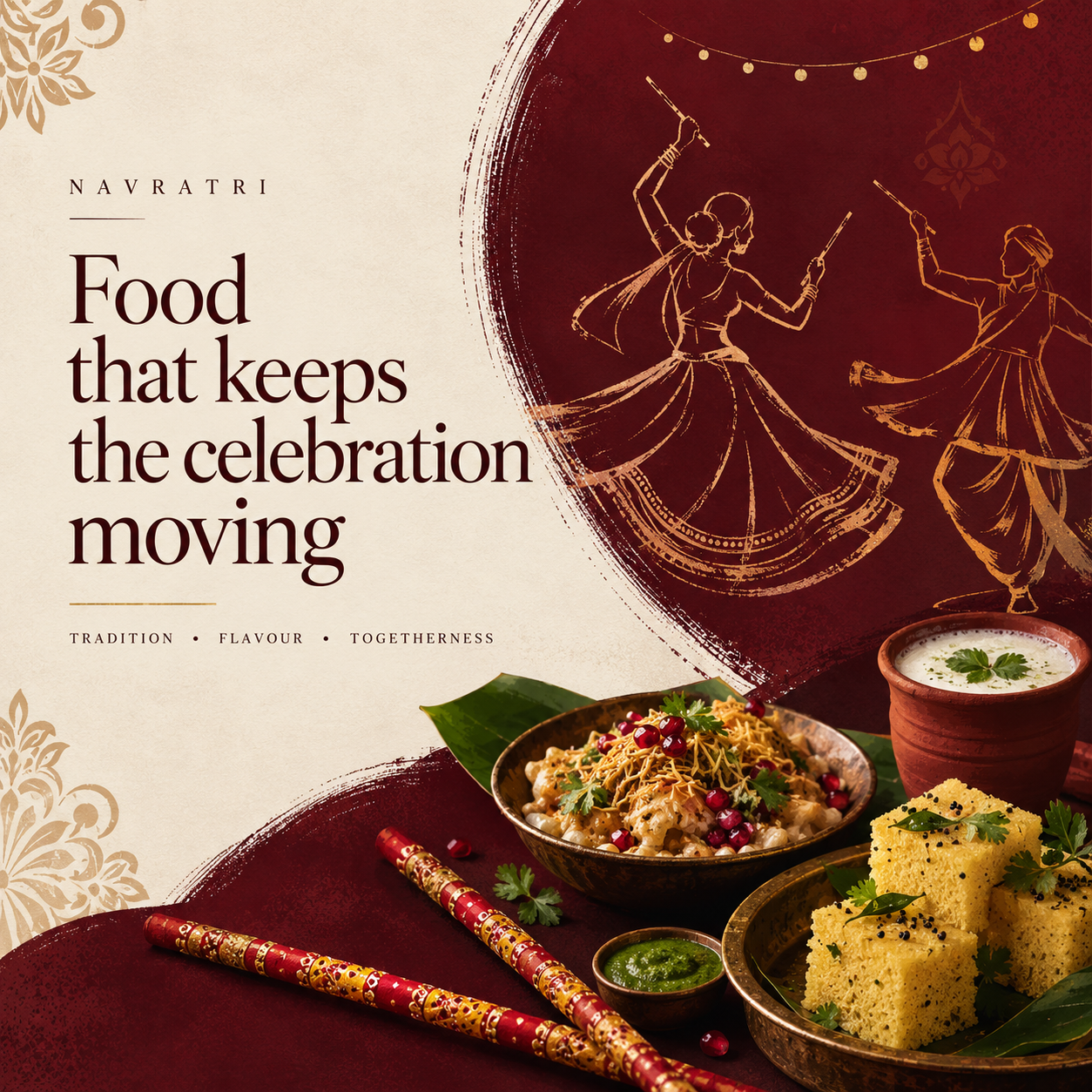
Navratri and Garba Night Catering: Feeding a Room That Never Stops Dancing
There is a particular kind of catering challenge that only reveals itself once you have actually stood at the edge of a Garba floor and watched what happens to a room full of people the moment the dhol picks up tempo. Nobody sits down. Nobody lingers over a plate. The energy simply does not stop for nine nights, and if your food cannot keep pace with that energy, it does not matter how good it tastes — it will not get eaten the way it deserves to be.
Navratri is unlike any other catering occasion in the Indian and Gujarati calendar. It is not a seated wedding breakfast. It is not a formal reception where guests settle into their places for the evening. It is nine consecutive nights of dancing — the swirling, circular rhythm of Garba and the clashing sticks of Dandiya Raas — performed by guests who came dressed specifically to move, and who intend to keep moving for hours at a time.
Catering for this kind of event requires an entirely different approach to almost everything a caterer would normally plan around. This is what that approach actually looks like, and why getting it right matters so much to the people who wait all year for these nine nights.
Understanding What Navratri Actually Asks of a Caterer
Navratri, meaning “nine nights,” is one of the most significant festivals in the Hindu and Gujarati calendar, honouring the goddess Durga across her nine forms over nine consecutive evenings. For the Gujarati community in particular, both in India and across the diaspora in the UK, Navratri is inseparable from Garba — the traditional circular dance performed around a central shrine or lamp, joined later in the evening by Dandiya Raas, where dancers strike decorated sticks together in rhythmic pairs.
What makes this festival so distinct from a catering perspective is the sheer physicality of it. A wedding guest might dance for twenty minutes across an entire evening. A Navratri guest, particularly the younger crowd and the genuinely devoted regulars who attend every single night of the nine, might dance for three or four hours without a proper break. They arrive already dressed in vibrant chaniya cholis and kediyus, often having changed outfits between nights to showcase a different colour or style each evening, and the last thing on their mind when they walk through the door is a long, formal sit-down meal.
This changes everything about how food should be designed, timed, and served.
Why the Traditional Buffet Model Doesn’t Quite Work
At a wedding or a corporate event, the buffet model works because the room has a natural rhythm — arrival, drinks, starters, a lull for speeches or entertainment, then the main course, then dessert. Guests move through that sequence together, more or less, and the catering timeline follows the event timeline.
Navratri has no such structure. The dance floor is the entire event. Guests arrive at staggered times across a two-to-three-hour window, some for the full evening and others dropping in for an hour between other commitments. They circle in and out of the dancing continuously rather than in one collective wave, which means a traditional buffet — set up once, served once, cleared once — simply does not match how people actually move through the room.
What works instead is food designed around the dance floor itself, not around it. Grazing formats, continuous service, and dishes engineered specifically to be eaten quickly, cleanly, and without derailing the momentum of the evening.
What Should Actually Be on a Garba Night Menu
Handheld, one-bite food is essential. Anything that requires a knife and fork, careful plating, or sitting still to eat properly is fighting against the entire nature of the event. Dhokla, cut into small squares and served with a light tempering of mustard seed and curry leaf, works perfectly — soft, easy to eat standing up, and gone in two bites. Khaman, Khandvi, and small vegetable patties like Aloo Tikki serve the same purpose. Papdi Chaat and Sev Puri, assembled at a live station, give guests something with real flavour and texture that can be eaten in under a minute between songs.
Live stations outperform static tables. A live chaat counter, a pav bhaji station, or a fresh dosa corner does more for a Navratri crowd than any elaborately laid buffet ever will, because it lets guests grab something quickly, on their way past, without breaking their evening’s momentum to sit down. The theatre of watching food being made fresh also fits the high-energy, high-visibility nature of the event itself — everyone is already performing for each other on the dance floor, and a live station becomes part of that same spectacle.
Hydration matters as much as food. This is something inexperienced caterers consistently underestimate. Guests dancing continuously for hours lose fluids fast, and a Navratri event without proper hydration stations — chaas (spiced buttermilk), fresh lime water, and simple still water readily available at multiple points around the room — is a genuine oversight, not just a nice-to-have. Chaas in particular has a cultural resonance here too, being a traditional Gujarati drink that cools and settles the stomach between bursts of dancing.
Sweet bites should be small and frequent, not one large dessert course. Small pieces of Mohanthal, bite-sized Gulab Jamun, and fresh Jalebi from a live station work far better than a formal dessert course, because guests want something sweet to grab on their way back to the floor, not a reason to sit down and finish a plate.
Vegetarian throughout, without exception. Navratri is traditionally observed as a period of fasting and dietary discipline for many devotees, and even guests who are not strictly fasting will expect the entire menu to be vegetarian, often avoiding onion and garlic in at least some dishes out of respect for those who are observing more strictly. A caterer who understands this without needing to be told is a caterer who understands the occasion properly.
The Timing Problem — and How Experienced Caterers Solve It
Because guests arrive across a staggered window and move continuously between dancing and eating rather than in one collective sitting, food service at a Navratri event has to run on a completely different clock to a wedding or corporate function.
Rather than a single service window, the strongest approach is continuous replenishment across the full length of the evening — typically three to four hours of near-constant activity at the food stations, with fresh batches arriving regularly rather than one large initial spread that sits and depletes. This requires a kitchen team that understands pacing rather than a single big push, and front-of-house staff who are constantly monitoring station levels rather than checking in periodically.
It also requires genuine flexibility around what “peak service” even means. At a wedding, peak service is a predictable, plannable window. At Navratri, peak service might come in three or four separate surges across the evening, each one triggered by a lull in the dancing rather than a scheduled mealtime. Caterers who have worked enough of these events learn to read the floor itself — watching when the tempo drops, when a slower Garba cycle begins, when the crowd naturally starts drifting toward the food — and timing their freshest batches to land exactly then.
Nine Nights, Not One Event
One further consideration that makes Navratri catering genuinely distinct: for many venues and community organisations, this is not a single evening to plan for, but nine consecutive nights, often across consecutive days with very little turnaround time in between.
This demands a level of operational consistency that a one-off wedding simply doesn’t require. The Dhokla on night seven needs to taste exactly as good as the Dhokla on night one. The chaat station needs to run with the same energy on a Wednesday as it did on the opening Friday. Menus are often varied slightly across the nine nights to keep things interesting for the community members attending every single evening, while maintaining the same quality standard throughout — which requires genuine kitchen discipline rather than a single strong performance.
For community organisations, temples, and cultural associations planning a full nine-night Navratri celebration, this consistency across the run is arguably the single most important thing to look for in a caterer. Anyone can deliver one excellent evening. Sustaining that standard across nine consecutive nights, often for the same returning crowd, is a different order of challenge entirely.
Why This Matters Beyond the Food Itself
There is something worth saying about what Navratri actually represents, beyond the practical catering considerations. This is a festival built entirely around community, movement, and joy expressed physically rather than through stillness. Unlike a wedding, where the food is often the centrepiece around which the event is built, at Navratri the dancing is the centrepiece, and the food exists to support it — to keep people fuelled, hydrated, and able to keep celebrating without interruption.
Getting this right is, in its own way, an act of genuine hospitality. It means understanding that your role as a caterer is not to be the star of the evening, but to be invisible in the best possible sense — always there when someone needs a bite between songs, never in the way of the dance floor, never requiring anyone to sit down and pause their evening to be properly fed.
The best Navratri catering doesn’t ask anyone to stop dancing. It simply makes sure that when they finally do pause, even for thirty seconds, there is something genuinely delicious waiting for them.